LED diodes are a fundamental building block for hobbyists, students, and professionals working on electronics, Arduino, and STEM projects. This article highlights five practical 5mm LED kits that cover a range of colors, voltages, and wiring configurations. Each kit is suitable for experiments, indicators, and DIY lighting, helping creators test circuits and bring projects to life with reliable, visible illumination.
Summary at a glance: the following table compares key product attributes to help you pick quickly.
| Product | Colors Included | Voltage Range | Wiring/Lead | Approx. Quantity |
|---|---|---|---|---|
| California JOS 50 PCS Colorful 5mm LED Kit | White, Red, Green, Blue, Yellow | 3V–3.2V (White/Blue/Yellow, etc.); 1.8V–2.2V (Red/Green) | Free-standing diodes (no prewire) | 50 pieces |
| EDGELEC 120pcs Prewired 12V LEDs | White, Red, Yellow, Green, Blue, Orange | DC 12V | Prewired with resistors (7.8″ leads) | 120 pieces |
| BOJACK 500 Pcs 5mm Assorted LED Kit | Five colors (assorted) | R/Y 2.0–2.2V; B/G/W 3.0–3.2V | Standard 5mm diodes (through-hole) | 500 pieces |
| DiCUNO 450pcs 5mm LED Kit | White, Red, Yellow, Green, Blue | Red/Yellow 2.0–2.2V; Blue/Green/White 3.0–3.2V | Through-hole 5mm LEDs | 450 pieces |
| EBOOT 100 Pieces 5mm LED Set | Red, Green, Blue, White, Yellow | Red/Yellow/Green 1.8–2.0V; Blue/White 3.0–3.4V | Free-standing diodes | 100 pieces |
These selections balance color variety, voltage ranges, and project versatility—from classroom demonstrations to Arduino experiments and decorative lighting. Each entry uses standard 5mm LEDs, making them compatible with breadboards and basic soldering setups while supporting quick prototyping and experimentation.
California JOS 50 PCS Colorful 5mm LED Kit

The California JOS kit features five colors in a compact 5mm form factor. Forward voltage varies by color, with White/Blue/Yellow typically around 3V, and Red/Green around 1.8–2.2V. The kit’s diodes are suitable for STEM experiments, Arduino projects, and signaling indicators. With 50 pieces across five colors, this set supports multiple small-scale builds and demonstrations, including breadboard experiments and basic LED matrices.
EDGELEC 120pcs Prewired 12V LEDs

EDGELEC offers a larger assortment with prewired LEDs designed for 12V operation. Each LED includes a built-in resistor, simplifying circuit design for beginners and quick test rigs. The kit includes six colors in equal quantities and long prewired leads (7.8 inches). This configuration reduces the need for soldering and is well-suited for prototyping indicators, decorative lighting, and classroom demonstrations that run on a 12V supply. Lifespan is rated at tens of thousands of hours, supporting long-term hobby projects.
BOJACK 500 Pcs 5mm LED Assorted Kit

BOJACK’s extensive 500-piece kit provides a broad color mix across five colors, each LED rated at 20 mA typical current with forward voltages around 2.0–3.2V depending on color. This kit is advantageous for educational projects, LED light bars, and hobby builds that require many small indicators or colorful display elements. The large quantity supports scaling experiments, prototyping, and replacement parts for ongoing projects or classroom activities.
DiCUNO 450pcs 5mm LED Kit

DiCUNO presents a carefully balanced 450-piece assortment in five colors. Forward voltages are color-dependent, with Red/Yellow around 2.0–2.2V and Blue/Green/White around 3.0–3.2V, and a typical 20 mA maximum current. The kit is designed for DIY lighting projects, science experiments, and indicator circuits, with a viewing angle around 30 degrees. The assortment is especially useful for classroom activities, breadboarding practice, and small project builds requiring multiple color LEDs for signaling or decorative effects.
EBOOT 100 Pieces 5mm LED Set
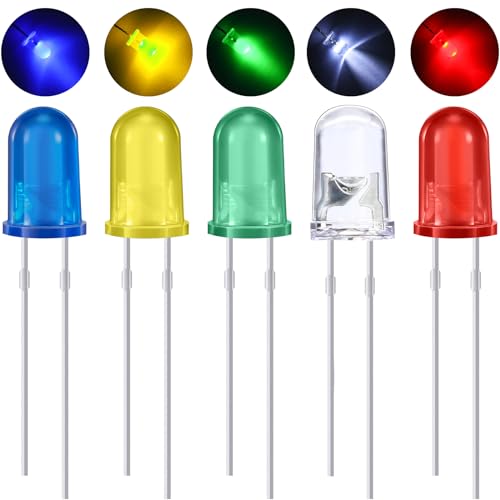
EBOOT’s 100-piece set focuses on five colors with water-drop style clear heads. Forward voltages span 1.8–2.0V for red, yellow, and green, and 3.0–3.4V for blue and white, with a 20 mA max current. This kit is well-suited for introductory experiments, student projects, and quick proof-of-concept demonstrations. The color variety helps illustrate color-mixing concepts and signal indicators in compact electronics builds.
Buying Guide: Key Considerations for LED Diodes in Electronics Projects
- Color range and color accuracy: Choose kits with colors that match your project’s needs for signaling, indicators, or display aesthetics. Diffused vs. clear lenses affect light diffusion and visibility.
- Voltage and current specifications: Be mindful of forward voltage and current to avoid overloading LEDs in your circuits. Kits with resistors prewired for certain voltages can simplify beginners’ setups.
- Wiring configuration: Prewired LEDs reduce soldering time, especially for rapid prototyping. Free-standing diodes require breadboarding or PCB mounting.
- Quantity and scalability: Larger kits support ongoing experimentation, multiple projects, and classroom use. Ensure the color mix aligns with your typical application space.
- Physical size and form factor: The 5mm standard is widely compatible with breadboards and PCBs. Some kits include 3mm options; consider the required brightness and footprint.
- Durability and longevity: LED lifespans vary by manufacturer and usage. Look for kits with clearly stated duty cycles and robust connectors to support repeated use.
- Documentation and compatibility: Clear datasheets or product notes help with integration into microcontroller projects (Arduino, Raspberry Pi) and signal indicators in 12V or low-voltage systems.
- Expansion potential: If you plan to scale up, consider kits that include a mix of colors and voltages to cover diverse project needs without frequent replacements.
When assembling LED diodes for electronics education, hobby builds, or prototyping, select kits that balance color variety, voltage range, and practical wiring options. The five highlighted products offer practical choices for a wide range of beginner to intermediate projects, with attention to ease of use, durability, and compatibility with common development platforms.
Buying Guide: Quick Comparisons
- Best for beginners: Kits with prewired LEDs and straightforward 12V operation reduce soldering and simplify circuit creation.
- Best for classroom use: Large quantity assortments with multiple colors support diverse demonstrations and group activities.
- Best for color-focused projects: Multi-color sets enable signaling patterns, LED indicators, and decorative effects in prototypes.
- Best for flexible experimentation: Mixed-size kits that include both 3mm and 5mm LEDs offer brightness and footprint variations for different layouts.