Choosing the right LC to MT-RJ patch cable is critical for reliable fiber connectivity in data centers, LANs, and enterprise networks. This guide highlights five well-regarded options with LC-to-MT-RJ or closely related LC configurations, summarizing key specs, applications, and considerations to help you pick cables that meet performance and compliance needs.
style=”display:none;”>Summary Table of Chosen Products
| Product | Connectors | Fiber Type | Length | Key Use |
|---|---|---|---|---|
| Jeirdus MTRJ Female to LC Patch Cable | MTRJ to LC | OM2 Multimode | 1 m | Fast Ethernet, Gigabit Ethernet, data centers |
| RiteAV 2M OM1 LC to MTRJ Patch Cable | LC to MTRJ | OM1 Multimode | 2 m | Data centers, enterprise networks |
| FCD OM1 MTRJ LC Duplex Patch Cable | MT-RJ to LC | OM1 Multimode | 4 m | High-speed fiber networking in buildings, datacenters |
| FLYPROFiber LC to LC OS2 Patch Cable | LC to LC | OS2 Single Mode | 1 m | 10G/40G/100G ethernet; LANs and data centers |
| AddOn LC to MT-RJ Patch Cable | LC to MT-RJ | OM1 Multimode | 1 m | Data transmission in telecom and LANs |
Jeirdus MTRJ to LC Patch Cable — 1m

Product overview: This orange-jacketed cable features an MTRJ (Male to Female) connector on one end and an LC connector on the other, designed for multimode OM2 fiber. Its 2.0 mm diameter jacket and 50/125 micron core support fast Ethernet, Gigabit Ethernet, and various data center applications. The product complies with common fiber standards and RoHS specifications, making it suitable for premises and educational environments as well as commercial settings.
- Connector pairing: MTRJ to LC
- Fiber: Multimode OM2 (50/125 μm)
- Bandwidth and attenuation: OM2 characteristics with typical performance for 850 nm and 1300 nm light sources
- Jacket: Orange LSZH, 2.0 mm diameter
- Standards: TIA/EIA 492AAAA, IEC 60793-2-10 A1b, RoHS
RiteAV 2M OM1 LC to MTRJ Patch Cable

Product overview: This 2-meter OM1 multimode cable provides an LC-to-MTRJ interface, making it suitable for connecting LC ports to MT-RJ-equipped gear. It supports high-speed networking needs in data centers and enterprise environments, with robust multimode performance designed for shorter to mid-range links typical of internal networks.
- Fiber: Multimode OM1 (62.5/125 μm)
- Length: 2 m
- Applications: Data centers, telecommunications, enterprise networks
- Connector pairing: LC to MT-RJ
FCD OM1 MTRJ LC Duplex Patch Cable

Product overview: This OM1 multimode MTRJ-to-LC duplex jumper is designed for higher-speed fiber networking in buildings, data centers, and telecom environments. The orange jacket identifies multimode use, and the product adheres to common industry standards for reliable performance across typical data center applications.
- Jacket: Orange OM1 MMF
- Mode: Multimode
- Connectors: MT-RJ and LC
- Typical uses: Data centers, LANs, telecommunications
FLYPROFiber LC to LC OS2 Patch Cable

Product overview: While primarily an LC-to-LC OS2 single-mode cable, this option is included to illustrate OS2 deployments that may intersect with MT-RJ workflows in mixed environments. OS2 cables use 9/125 μm fiber for long-distance, high-bandwidth applications with low attenuation and excellent return loss, suitable for enterprise and data-center installations that require long-haul capabilities.
- Fiber: Single-mode OS2 (9/125 μm)
- Connectors: LC to LC
- Bandwidth: High performance for 10G/40G/100G networks
- Jacket: LSZH
AddOn LC to MT-RJ Patch Cable — 1 m
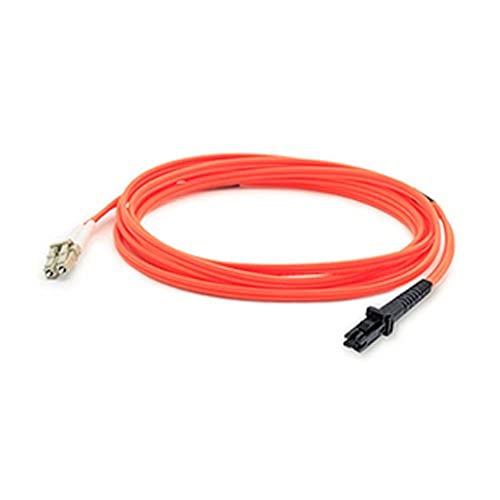
Product overview: This 1-meter LC-to-MT-RJ patch cable provides a reliable LC-to-MT-RJ connection, with orange OM1 MMF jacket. It’s designed for telecom and data center networks donde MT-RJ-equipped devices require LC-side access. Intended for quick plug-and-play deployments in mixed equipment environments.
- Fiber: OM1 Multimode
- Connectors: LC to MT-RJ
- Jacket: Orange LSZH
- Use cases: Data transmission in LANs, telecom, data centers
Buying Guide: Key Purchase Considerations
When selecting LC to MT-RJ patch cables, consider the following factors to ensure compatibility, performance, and reliability:
-
<li Connector pairing and fiber type: Verify the exact connector ends (LC, MT-RJ) and whether multimode (OM2/OM1) or single-mode (OS2) fiber best fits your network topology and distance requirements.
<li Length and bend radius: Choose lengths that fit your rack or path layout. Note minimum bend radius values, particularly for multimode cables, to prevent insertion loss or damage.
<li Jacket material and rating: LSZH jackets reduce smoke emission in case of fire, enhancing safety in data centers and crowded installations.
<li Attenuation and bandwidth: For multimode, check attenuation at relevant wavelengths (e.g., 850 nm, 1300 nm) and bandwidth ratings to ensure adequate performance for Ethernet speeds (1G, 10G, etc.).
<li Standards and compliance: Look for RoHS compliance and adherence to TIA/EIA or IEC standards for compatibility with standard fiber optic equipment.
<li Environmental suitability: Consider operating temperature ranges and indoor/outdoor usage to select cables that withstand your facility’s conditions.
<li Use-case alignment: Data centers and enterprise networks often demand low insertion loss and high return loss; ensure cables meet these performance markers for your transceivers and switches.
<li Availability and variants: Some vendors offer multiple lengths and combinations (e.g., LC to MT-RJ vs. MT-RJ to LC). Ensure you purchase the exact pairing for your devices to avoid compatibility issues.
In summary, your choice should balance connector compatibility (LC vs MT-RJ), fiber type (OM1/OM2 vs OS2), and the physical constraints of your deployment. The options above cover common data-center and LAN scenarios, providing a range of lengths, materials, and configurations to support robust fiber connections.