For off-grid living, RVs, and backup power, a reliable inverter charger that supports lithium batteries is essential. This guide highlights five top-rated options, detailing how they handle pure sine wave output, Li-ion compatibility, charging control, and safety protections. Each model provides a distinct mix of power, efficiency, and charging flexibility to suit different battery chemistries and usage scenarios.
| Product | Brand | Output (W) | Battery Types | Notes |
|---|---|---|---|---|
| Ampinvt 2000W Peak 6000W | AMPINVT | 120V AC, 2000W continuous | SLA/AGM/GEL/Li-ion, LiFePO4 | Pure Sine Wave, LCD, adjustable charging |
| ECO-WORTHY 1000W | ECO-WORTHY | 110V AC, 1000W | 12V LiFePO4, SLA/Lead-acid | UPS function, 55A charging |
| Ampinvt 1200W Pure Sine Wave | AMPINVT | 120V AC, 1200W | SLA/AGM/GEL/Li-ion, LiFePO4 | AC charger, AVR stabilizer |
| Renogy REGO 3000W | Renogy | 12V DC to 120V AC, 3000W | Gel/AGM/SLA/Lithium | Built-in Bluetooth, high efficiency |
| Redodo 3000W | Redodo | 12V DC to 120V AC, 3000W | Lithium & various batteries | Uninterruptible power, 9000W surge |
AMPINVT 2000W Peak 6000W Pure Sine Wave Inverter Charger

The AMPINVT model combines an inverter, battery charger, and AC auto-transfer switch with high transfer efficiency over 90%. It delivers continuous pure sine wave output suitable for sensitive electronics and heavy loads. It supports multiple battery chemistries including Li-ion and LiFePO4, with adjustable charging currents up to 35A. The unit can turn off charging when set to 0A, providing flexible control for lithium life cycles and maintenance regimes.
ECO-WORTHY 1000W Pure Sine Wave Inverter Charger

This 2-in-1 unit blends a 1000W inverter with a 55A lithium battery charger, providing a peak of 2000W. It includes an automatic UPS transition within 20 milliseconds during grid outages to keep devices powered. Built for LiFePO4 and other Li-ion chemistries, it uses pure sine wave output and includes protection against voltage, current, temperature, and short circuits to safeguard connected equipment.
AMPINVT 1200W Pure Sine Wave Inverter

This 1200W pure sine wave inverter is designed as an inverter, charger, and AC auto-transfer device. It maintains high efficiency, offers AVR stabilizer, and supports a variety of battery chemistries including LiFePO4. The adjustable charging current ranges from 0 to 15A, with 0A turning off charging, enabling precise control over lithium battery charging cycles.
Renogy REGO 3000W Pure Sine Wave Inverter Charger

The REGO 3000W inverter charger delivers up to 3000W continuous output with peak power up to 9000W and efficiency above 90%. It supports multiple battery types including LiFePO4 and AGM, with a user mode for customizing charging. Built-in Bluetooth enables monitoring via the Renogy app, offering convenient remote status checks and configuration.
Redodo 3000W Pure Sine Wave Inverter Charger
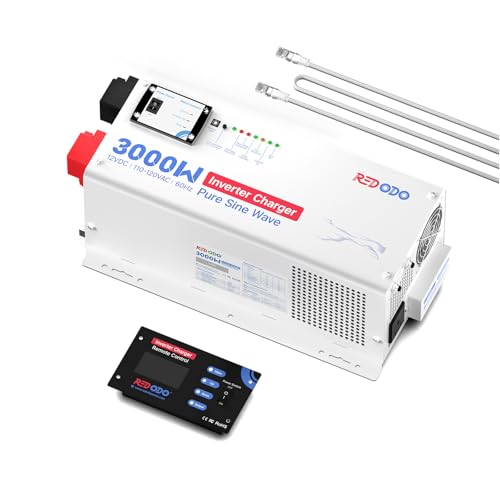
Redodo’s 3000W all-in-one inverter-charger integrates a 3000W pure sine wave inverter with a 45A charger and a surge capacity up to 9000W. It enables seamless transition between grid and battery power for uninterrupted use of appliances like air conditioners and refrigerators. Compatible with a wide range of battery types, including LiFePO4 and other lithium variants, this unit emphasizes reliability for off-grid and backup scenarios.
Buying Guide
- Power and surge requirements: Match inverter wattage and peak surge with your largest continuous-load appliances to avoid tripping.
- Battery compatibility: Check which chemistries are supported (LiFePO4, Li-ion, AGM, GEL) and whether the charger supports your battery bank.
- Charging current and control: Look for adjustable charging current and programmable voltage to optimize lithium battery lifespan.
- Efficiency and heat management: Higher efficiency reduces energy loss; consider units with good heat sinking and cooling if used in hot environments.
- Protection features: Essential protections include over/under voltage, overcurrent, short-circuit, and over-temperature safeguards.
- UPS and transfer speed: If grid outages are common, a fast 20 ms or better transfer ensures minimal device disruption.
- Monitoring and connectivity: Bluetooth or app-based monitoring helps track status, voltage, and charging status.
- Installation flexibility: Assess whether the unit supports AC-DC auto-transfer, generator compatibility, and remote monitoring options.