This guide highlights top in-line signal boosters across audio, TV, USB, HDMI, and networking uses. Each product is evaluated on boost power, noise reduction, interference protection, and ease of use to help you pick the right inline amplifier for your setup. The selection below focuses on practical enhancements for home studios, living rooms, and digital entertainment systems.
| Product | Brand | Key Benefit |
|---|---|---|
| dBooster in-line Signal Booster | Royer Labs | High-gain mic signal boost with Class-A preamp and RF protection |
| LT Easiyl 2pcs 20dB Inline Amplifier | LT Easiyl | Versatile 10-2400MHz inline boost for DVB-T and satellite signals |
| The CIMPLE CO Antenna Amplifier Kit | THE CIMPLE CO | Coaxial distribution amplifier with up to 24 dB gain for indoor TV |
| StarTech HDMI Signal Booster | StarTech.com | HDMI inline repeater with adjustable equalization for long runs |
| GE Indoor HD Digital TV Antenna Amplifier | GE | Low-noise amplifier with 4G/5G filter for clear HDTV reception |
Below are five carefully chosen in-line signal boosters. Each section provides a concise overview, notable features, and practical considerations to help you compare and decide without overpaying for capabilities you might not need.
dBooster in-line Signal Booster

The Royer Labs dBooster is a high-performance inline signal booster designed to significantly increase microphone output. It features a true Class-A input stage to deliver crystal-clear gain with minimal noise and self-distortion, ensuring the microphone’s natural tone is preserved. Its robust RF protection helps maintain signal integrity in environments with potential interference, making it suitable for studios, podcasts, and live performances.
Considerations: Suitable for passive microphones and studio environments where low noise is essential. The device emphasizes clean amplification and interference resistance rather than consumer-grade plug-and-play convenience. Ideal for users seeking substantial gain without compromising sound quality.
GE Indoor HD Digital TV Antenna Amplifier
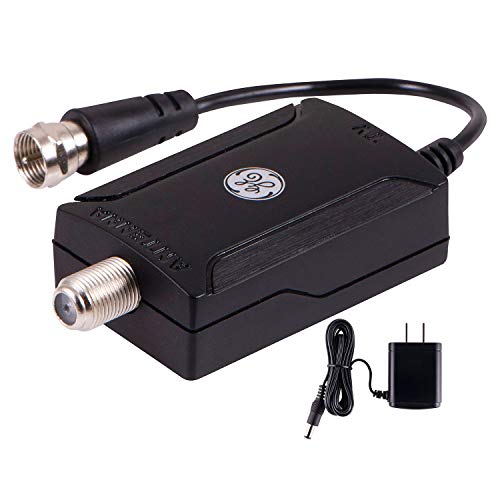
GE’s indoor TV antenna amplifier provides universal compatibility and 1080p/4K readiness for a broad range of TVs and antennas. It includes PureAmp Technology, which integrates a 4G/5G LTE filter to block cellular interference, helping to deliver clearer HDTV, VHF, and UHF reception. It acts as a signal booster to compensate for cable loss and reduces reception dropouts, though results depend on distance to towers and obstacles.
Considerations: Best for users seeking improved local channel reception with minimal setup and digital interference suppression. Performance varies with antenna placement and proximity to broadcast sources.
TV Antenna Amplifier Signal Booster by HIDB

HIDB’s TV antenna booster emphasizes adjustable gain with a user-friendly approach. It offers up to strong amplification, and the product highlights a digital time display feature, aiding in managing viewing sessions. It notes that boosting is most effective when existing signals are weak and that distance from towers and obstacles influence channel availability and quality.
Considerations: Useful for indoor setups where channel strength is borderline. The product’s emphasis on adjustable dBi gain and timer features may appeal to users who want precise control over signal amplification and viewing planning.
THE CIMPLE CO Antenna Amplifier Kit
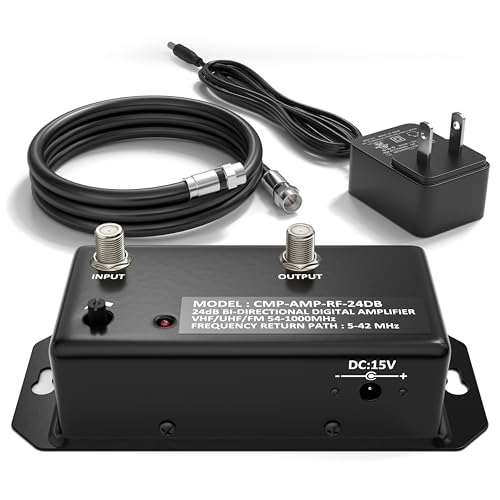
The CIMPLE CO Antenna Amplifier Kit includes a TV antenna amplifier and RG6 coaxial cable, delivering up to 24 dB gain for indoor VHF/UHF/FM reception. It is designed to strengthen existing signals with minimal distortion, but it should be noted that this amplifier is most effective when you are within range of a broadcast location and your antenna is adequately sized to receive the signal. It is intended for indoor use only.
Considerations: A practical option for improving broadcast reception in urban or suburban indoor settings. Check broadcasting distance and antenna compatibility before purchasing to avoid diminishing returns from over-amplification.
LT Easiyl 2pcs 20dB Inline Amplifier

LT Easiyl offers two inline amplifiers with up to 20 dB gain, designed for wide frequency coverage from 10 to 2400 MHz. This makes them versatile for DVB-T and satellite applications, supporting clear signal transmission for various broadcasting standards. The compact 40 mm form factor and durable construction support reliable use across extended periods.
Considerations: A solid choice for users needing flexible inline boosting across multiple signal types. Ensure the amplifier’s frequency range matches your equipment’s requirements for best results.
StarTech HDMI Signal Booster

StarTech’s HDMI signal booster provides inline amplification between HDMI cables, supporting up to 82 feet input and 33 feet output lengths in typical setups. It includes mounting hardware and does not require a separate power adapter for standard use. An adjustable equalization switch with multiple levels lets you tailor signal amplification based on cable distance and quality.
Considerations: Ideal for long HDMI runs where signal integrity degrades. Works without extra power in many configurations, but heavier cables or extreme distances may require external power for optimal performance.
Buying Guide: Key Considerations for In-Line Signal Boosters
- Signal type and compatibility: Confirm the booster is designed for your signal type (audio mic, TV antenna, HDMI, Wi-Fi, etc.) and supports your frequency ranges.
- Gain and noise performance: Higher gain can improve reception but may introduce distortion if the source signal is already strong. Look for boosters with low noise figures and class-A or equivalent input stages when audio clarity matters.
- Interference protection: RF filtering and interference shielding are essential in busy environments (city apartments, near cell towers, or dense home networks).
- Power requirements: Some boosters are passive, while others require external power. Ensure you have the appropriate outlets or USB/adapter options.
- Placement and cable considerations: Inline boosters work best when placed close to the signal source or near the point of signal loss. Cable length and quality affect overall performance.
- Indoor vs outdoor suitability: Many TV and antenna boosters are designed for indoor use; outdoor use may require weatherproof housings and more robust connectors.
- Ease of installation: Some units offer plug-and-play operation, while others benefit from technical tuning (adjustable gain, equalization, or timers) to maximize performance.
- Applications and use cases: Decide whether you need mic-level amplification for recording, TV reception enhancement, HDMI signal extension, or network/Wi-Fi boosting to determine the right type and size of booster.