The right guitar amp attenuator lets players push their amp’s power section for creamy overdrive while keeping stage volume friendly. This guide reviews five top options that balance tone, signal integrity, and practical features for practice, recording, and live performance. Each pick is evaluated for impedance compatibility, output options, and how closely the attenuated signal preserves the amp’s character.
| Product | Brand | Key Benefit | Impedance Support |
|---|---|---|---|
| Bugera POWER SOAK PS1 | Bugera | Emulated mic output for direct console or interface recording | 4, 8, 16 Ohms |
| GearNuts Bugera PS1 Bundle | GearNuts | Includes a 6-foot TS-TS speaker cable for flexible setups | 4, 8, 16 Ohms |
| Donner Amp Attenuator Pedal | Donner | Mute/Low-volume feel with true bypass for dynamic tone | Depends on amp input/output |
| Parts Express L-Pad 100W | Parts Express | Simple level control while preserving 8 Ohm impedance | 8 Ohms |
| Pyle DI Box 1/4″ Box | Pyle | Direct input with hum/buzz cancellation for clean DI tone | Instrument level (unbalanced) to balanced |
Note: All products listed are designed to reduce overall loudness while preserving or shaping tonal characteristics. When possible, connections should match your amplifier’s impedance to avoid mismatch and ensure safe operation.
Bugera POWER SOAK PS1 Passive 100W Attenuator

The Bugera PS1 is a passive 100-watt power attenuator with multiple impedance inputs (4, 8, and 16 ohms) to match a wide range of guitar or bass amplifiers. A line output with a dedicated Level control provides direct connection for recording or PA use, while the emulated mic output helps capture a mic’d cabinet feel without a microphone. This setup supports studio-like flexibility with minimal signal loss at reduced volumes.
GearNuts Bugera PS1 Attenuator + 1/4″ Cable Bundle

This bundle combines the Bugera PS1 passive 100-watt attenuator with a 1/4″ TS 3-foot speaker cable, making it easy to connect a head or combo to a cab or dedicated load. The PS1’s mic-emulated output is well-suited for home studios and small venues where miking every amp isn’t practical. It supports flexible tone shaping as you lower volume while preserving core dynamics and feel.
Donner Amp Attenuator Pedal EMO Box

The Donner EMO Amp Attenuator Pedal functions as a signal converter with a mute footswitch, allowing you to push the front end of your amp for dynamic tone at lower volumes. It preserves core dynamics through true bypassing and offers flexible tonal control through on-board knobs. Designed to work in conjunction with your amp’s FX loop for optimized attenuation without sacrificing response.
Parts Express 100W L-Pad Attenuator

This 100W mono L-Pad attenuator provides easy level adjustment while preserving 8-ohm impedance. It’s a practical choice for speaker design tweaking and ensuring consistent impedance as you dial back volume. Suitable for custom cabinets, guitar rigs, or DIY projects where precise attenuation is needed without tonal compromise.
Parts Express 50W L-Pad Attenuator

This 50W mono L-Pad offers a compact option for lower-power applications or quieter practice setups. Like the higher-wattage variant, it maintains 8-ohm impedance and facilitates easy level adjustment without altering the amp’s fundamental impedance. It’s well-suited for small rigs or bass-guitar combos where space and weight matter.
Bugera PS1 Bundle with S12-6 Cable

This bundle enhances the PS1 experience with a 6-foot speaker cable designed for demanding applications. The PS1 provides a passive 100-watt attenuation solution with multiple impedance inputs, plus emulated mic outputs that simulate a miked cabinet tone for direct console or interface use. It’s ideal for studio tracking and live performances where mic placement isn’t feasible.
Pyle Premium DI Box – Passive

The Pyle Direct Injection box provides a robust DI solution with impedance transformation and buzz/hum cancellation. It’s designed to connect guitars and basses to balanced XLR outputs, helping integrate amp tone into a FOH or recording chain while minimizing hum and noise. It complements attenuator use by offering a clean path for direct-signal capture when needed.
Pyle Premium DI Box – Passive (Black)
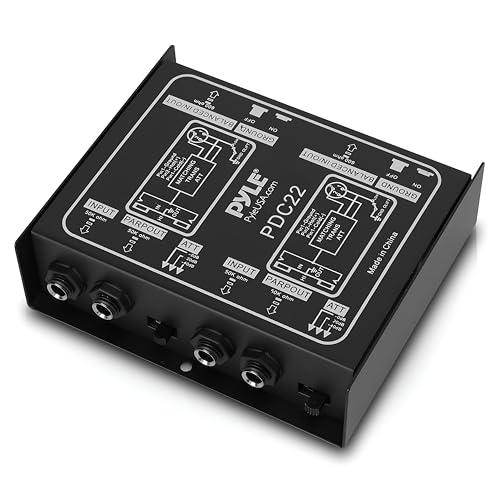
Another Pyle model, this passive DI box emphasizes clean DI performance for guitar and bass with impedance transformation and hum cancellation. It complements an attenuator’s tone shaping by ensuring the direct signal remains clean when routed to a PA or recording interface. The unit is compact and straightforward, suitable for small venues or rehearsal spaces.
Buying Guide: Key Purchase Considerations
- Power handling and impedance: Match the attenuator to your amplifier’s wattage and output impedance (commonly 4, 8, or 16 ohms). Incorrect matching can reduce tone integrity or stress components.
- Attenuation type: Passive attenuators preserve signal without active electronics, while active or emulated outputs provide direct recording or DI options. Consider whether you need a mic’d-cab feel or a clean direct signal.
- Output options: Look for line or XLR outputs for direct-to-console or interface use, and 1/4″ outputs for cab connections. An emulated mic output is valuable for recording without a mic.
- Series vs. standalone: Some bundles include speaker cables or accessories that simplify setup, but verify compatibility with your rig and room size.
- Level control precision: A well-labeled Level control helps dial in a consistent tone as you reduce volume, especially for live performances.
- Portability and build: For gigging musicians, weight, size, and chassis durability matter. Check the physical design for road-use durability.
- DI and recording workflow: If you record directly, prioritize devices with a robust DI path or cabinet-emulation outputs to better capture the amp’s tone without a mic.
- Noise considerations: Some DI boxes and attenuators include hum reduction and high-quality components to minimize tonal degradation.
- Compatibility with pedals and FX loop: If you rely on effects loops, ensure the attenuator or pedal integrates cleanly with your setup to preserve dynamics.
In practice, players choose attenuators to achieve the most musical overdrive at safe stage levels. When evaluating options, consider whether you value a direct studio tone, a mic’d-cab feel, or the flexibility of a quick takeaway DI signal for live or recorded work. The five products above represent a range of strategies—from classic passive attenuation with emulated cabinet outputs to convenient bundles and DI-focused units—allowing players to balance volume, tone, and workflow.