Grid tie wind inverters convert energy from small wind turbines into grid-compatible electricity. This article highlights five reliable models designed for low- to mid-range wind generators, with safety features like limiter sensors and MPPT to maximize harvest while protecting the grid and equipment. Each option below is evaluated on input voltage range, MPPT capabilities, output quality, and safety features to help you compare performance across common residential setups. User installation environments, battery compatibility, and the ability to scale with additional inverters are also covered in the buying guide.
Summary of chosen products
| Product | Brand | Model |
|---|---|---|
| Y&H 2000W Grid Tie Inverter with Limiter | Y&H | GRID TIE IL2 2000W |
| Marsrock 1000W Wind Grid Tie Inverter | Marsrock | 1000W Limiter MPPT |
| Y&H 1200W Grid Tie Inverter Power Limiter | Y&H | GRID TIE IL 1200W |
| Marsrock 1300W MPPT Pure Sine Wave Grid-Tie | Marsrock | 1300W MPPT Grid-Tie |
| Y&H 2000W Grid Tie Inverter Power Limiter LCD | Y&H | SUN-2000GTIL2-H |
Y&H 2000W Wind Power Grid Tie Inverter

The Y&H 2000W grid tie model supports a DC input range of 45–90V and a corresponding AC output compatible with American 240V systems. It includes a limiter sensor and a dump load control system, designed to prevent excess power from feeding the public grid. The device can operate with wind turbines that produce 3-phase AC output and maintains turbine speed by keeping voltages within the inverter’s rated range. The unit features high-voltage protection and an automatic self-disconnect when necessary, enhancing safety in variable wind conditions. It’s suitable for grid-tied setups where wind strength varies and peak power needs must be managed to avoid grid disturbances.
Key notes: The inverter’s anti-overvoltage behavior relies on the internal limiter mode to determine output based on load. Applications include small-to-mid-sized wind installations with direct solar or mixed energy setups that require reliable grid-tacing while avoiding unsafe surges. The product is positioned for hobbyists and small households needing a robust, automatic disconnect in high-wind scenarios.
Marsrock 1000W Wind Grid Tie Inverter

This Marsrock model provides 1000W of grid-tie power with a limiter sensor to supply only what the load requires, helping prevent waste and grid overloads. It emphasizes MPPT optimization to maximize energy capture, ensuring the wind turbine output is converted efficiently to AC power. The inverter also delivers a pure sine wave, which reduces electrical noise and protects sensitive appliances from potentially harmful harmonics. The device is designed for wind-powered systems connected to standard home electrical circuits, making it suitable for small wind installations integrated with existing grid connections.
Key details: MPPT-based efficiency helps stabilize output as wind speeds fluctuate. The unit’s design targets consumers seeking smooth, dependable power conversion for homes with modest wind resources. Consider this model when prioritizing clean sine wave output and intelligent power limiting for safe grid interaction.
Y&H 1200W Grid Tie Inverter Power Limiter

The Y&H 1200W Grid Tie Inverter focuses on limiter-based operation to deliver only the power the load demands, preserving energy and protecting the grid. It targets solar input voltage in a high MPPT range to maintain good output efficiency. The device features an LCD display showing inverter status and allows mode selection between photovoltaic and battery configurations. This model is suitable for households or microgrids where predictable, load-driven output is crucial for stability, especially in mixed energy systems where panels and small wind turbines share the grid.
Key considerations: Ensure the solar or wind source provides voltage within the inverter’s MPPT window for optimal performance. The LCD readout helps monitor status, and the limiter helps manage energy transfer during gusty wind or cloudy days when output can swing.
Marsrock 1300W MPPT Pure Sine Wave Grid-Tie Micro Inverter
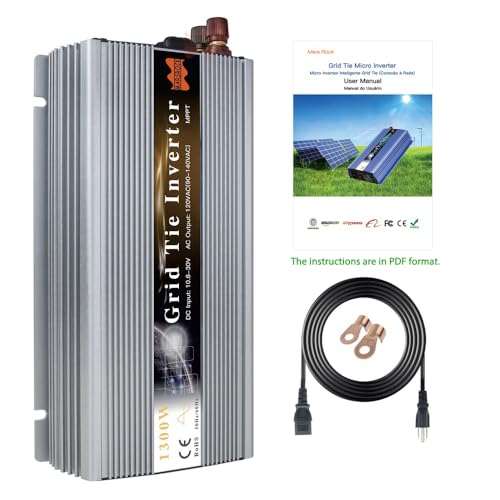
Marsrock’s 1300W MPPT grid-tie inverter emphasizes a compact form factor with advanced MPPT for efficient energy extraction. It outputs a pure sine wave suitable for sensitive electronics and household devices. The product is designed for home solar or wind power systems, supporting steady performance even as wind conditions vary. The combination of MPPT and pure sine output makes this model appealing for users who want reliable grid support while keeping electrical noise and waveform quality in check. It is well-suited for small, space-constrained installations that require high-quality power conversion.
Highlights: MPPT optimization, robust sine-wave quality, and a compact installation footprint. Prospective buyers should consider pairing with wind turbines that present a predictable DC input and have space for an efficient MPPT dance between wind variability and grid demand.
Y&H 2000W Grid Tie Inverter Power Limiter LCD Display

This high-capacity Y&H model supports DC input ranges from 49V startup up to 90V, designed for American 240V output. It accommodates solar panels with Voc up to about 76–90V and recommends matched panel specifications. The inverter includes a battery discharge power mode to optimize discharge and safe operation when batteries are part of the system. It also supports stacking multiple units to increase total output without a fixed ceiling, making it attractive for scalable grid-tied wind solutions. The built-in limiter ensures safe interaction with the grid when wind conditions spike and prevent overfeeding.
Buying guide: When selecting a grid-tie wind inverter, consider input voltage range, MPPT efficiency, output compatibility with your grid (240V vs 120V), limiter features, battery compatibility, and the ability to parallel multiple units for higher total power. If wind resources are variable, a unit with a robust limiter and smart disconnect is essential for grid safety. For households planning to expand, choose models that support stacking and easy field upgrades. Always follow local electrical codes and, if unsure, consult a licensed electrician for installation to ensure safe attachment to the grid.