Looking for a versatile card reader that covers a wide range of formats? This guide highlights five reliable USB card readers that support numerous memory card types, offer plug-and-play operation, and provide convenient data transfer between cards and your computer. Each option emphasizes compatibility with Windows, Mac, and Linux, while delivering fast access to your files.
Summary of chosen products:
| Product | Brand | Card Formats Supported | Notes |
|---|---|---|---|
| SABRENT 74 in 1 Internal Card Reader/Writer | SABRENT | 74 types including SD, CF, MS, XD, MMC, many others | |
| SABRENT 75 in 1 Multi Card Reader/Writer | SABRENT | 74 types plus power for USB devices | |
| BENFEI 4in1 USB 3.0 & USB-C Card Reader | BENFEI | SD/SDHC/SDXC, Micro SD, MS, CF (4 cards) | USB-C/USB 3.0 dual interface |
| StarTech 22-in-1 Front Bay USB 2.0 Reader | StarTech.com | CF/SD/MMC/MS/xD and more | Internal bay with front USB 2.0 port |
| Unitek USB 3.0 Card Reader | Unitek | CF/SD/TF, Micro SD, MMC, more (3-card read) | Aluminum exterior for speed |
All five options prioritize broad compatibility, fast transfers, and simple setup. The list includes both internal and external designs to fit desktop builds or laptop usage, ensuring you can access your photos, videos, and documents from virtually any memory card.
SABRENT 74 in 1 Internal Card Reader/Writer
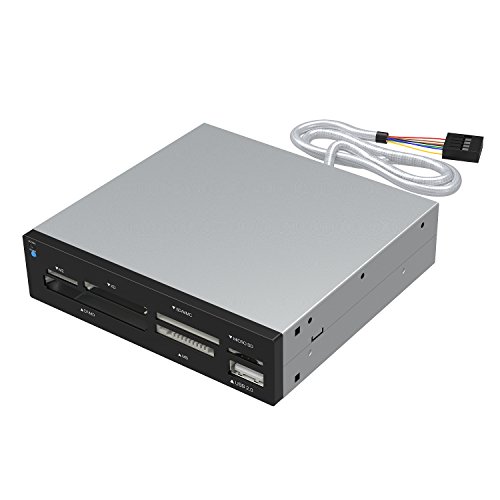
The SABRENT CR-USNT model provides a dense 74-card compatibility set, supporting a broad spectrum of memory formats. An internal power connector helps ensure USB hubs have sufficient power for connected devices, and the unit includes a USB 2.0 output for direct peripheral connections. This design is suited for desktop builds where multiple card formats must be accessed from a single slot array. Operating system compatibility spans Windows, Linux, and Mac OS X, enabling wide usage across different workstations.
Key features include extensive card type support, a utility-driven power management option, and a compact footprint that fits into standard PCI or drive-bay configurations. For users who regularly handle archival transfers or cross-brand media, this reader offers a unified interface for many formats without needing multiple adapters.
SABRENT 75 in 1 Multi Card Reader/Writer with Power Cord
The SABRENT CRW-UINB model mirrors broad compatibility with a focus on external power supply to maintain hub stability for multiple devices. Its 74-type support covers common and legacy formats, making it a strong choice for users with diverse memory cards, cameras, and other electronics. Compatibility spans Windows, Linux, and Mac OS X, ensuring that most standard computing environments can access data quickly and efficiently. The external power option can be crucial for devices that demand higher current, preserving performance under load.
In practice, this reader simplifies data migration, backups, and media management by consolidating formats into a single device. It is especially helpful for photographers or video editors who routinely work with a mix of card types from different cameras.
BENFEI 4in1 USB 3.0 and USB-C Card Reader

The BENFEI reader emphasizes speed and versatility with a 4-card design that supports SD, SDHC, SDXC, Micro SD, and CF via USB-C and USB 3.0 interfaces. Transfer speeds climb in USB 3.0 mode and remain backward compatible with USB 2.0. The two-in-one USB-C/USB 3.0 interface helps streamline usage with modern laptops and devices while remaining accessible to older systems. This makes it suitable for professionals who need rapid data access across various camera cards, smartphones, and tablets without carrying multiple adapters.
Performance notes highlight that data speeds depend on the card and host USB port type. The compact design is portable, which suits on-the-go workflows where you need to offload from memory cards quickly and reliably.
Unitek USB 3.0 Card Reader

The Unitek USB 3.0 Card Reader focuses on speed and versatility with support for CF, SD, TF/microSD, MMC, and related formats across a 3-card simultaneous read/write design. The USB 3.0 interface provides high-speed data transfer, while backward compatibility with USB 2.0 ensures broad device support. This reader is well-suited for users who need to transfer large media files, such as 4K video or high-resolution RAWs, from multiple cards at once. Its aluminum enclosure offers both durability and efficient heat management during long transfer sessions.
As a compact desktop accessory, it balances performance and portability. It is ideal for studios, freelance photographers, and tech enthusiasts who require quick access to multiple card types without swapping adapters mid-project.
Buying Guide: Key Purchase Considerations
- Card format coverage: Look for readers that support both common formats (SD, microSD, CF, MS, xD) and legacy cards you still use. More formats mean fewer adapters and more streamlined workflows.
- Interface and speed: USB 3.0 or USB-C interfaces deliver faster transfer rates than USB 2.0. If you frequently move large media files or 4K video, prioritize USB 3.x compatibility and PCIe-internal options when building a desktop setup.
- Power management: Some multi-card readers rely on the USB bus to supply power. If you use hubs or multiple peripherals, consider models with extra power connectors to prevent under-voltage issues.
- Internal vs external design: Internal readers fit in a drive bay and are tidy for desktop builds, while external or compact readers are ideal for laptops and travel. Choose based on your workspace and mobility needs.
- Driver and OS compatibility: Most modern readers support Windows, macOS, and Linux. Confirm support for your operating system version to avoid driver installation hassles.
- Build quality and heat: Aluminum or sturdy plastics help dissipate heat during long transfers. A robust enclosure reduces wear and prolongs device life in busy production environments.
- Number of simultaneous slots: If you often copy files between cards or from several cards at once, prefer readers that allow multiple simultaneous reads/writes without throttling.
When choosing, assess your typical card formats, your computer ports, and how often you transfer large media files. A reader that balances broad compatibility with fast speeds and reliable power handling will deliver the best long-term value for most American households and professional setups.