The following guide highlights five top digital talking alarm clocks ideal for seniors, visually impaired users, or those managing memory challenges. Each clock offers audible time announcements, customizable alarms, and accessibility features to reduce stress and gaps in daily routines. Below you’ll find concise product overviews, key features, and practical purchasing considerations to help you compare options quickly.
| Product | Brand | Key Benefit |
|---|---|---|
| GOLOZA 7″ Digital Dementia Clock | GOLOZA | Talking time, reminders, and pill alerts |
| MASSII 19 Alarms Digital Talking Clock | MASSII | 20+ reminders with loud voice and remote |
| High-volume, simple one-button use | ||
| Bovintex Medication Pill Reminder | Bovintex | Voice recordings and USB-powered reliability |
| ORKA Talking Clock | ORKA | Recordable alarms, multilingual voices |
GOLOZA 7” Digital Dementia Clock

GOLOZA’s 7” talking clock is designed to aid seniors with memory challenges or visual impairment. The device speaks the time aloud with adjustable volume, and it supports up to 10 voice volumes and multiple display colors. It includes birthday and holiday reminders, plus 3 pill reminders to help manage medications. An hourly chime option keeps users informed even when a caregiver isn’t nearby, making it a practical addition to daily routines. The auto-dimmable display reduces glare at night, supporting comfortable bedside use.
MASSII 19 Alarms Digital Talking Clock

MASSII offers a feature-rich talking clock with 20+ reminders and 19 alarms, including a robust voice output that clearly announces time, date, and day. The clock provides an advanced timer with dual controls, a soft-no-blue-light display, and a remote for distant operation. It supports custom reminders for medications, hydration, or daily activities, and includes an auto-change feature for daylight saving time. This model is well-suited for users who need a highly customizable schedule and strong audible prompts.
LEEPENK 2 Pack Talking Clocks

LEEPENK’s two-pack offers a simple, user-friendly design with a single top button to announce the time in a clear North American English voice. The clocks are particularly suitable for users with visual impairment or hearing loss, featuring a very loud 85 dB output. Their straightforward operation makes them ideal bedside companions or kitchen timers for seniors who require reliable, audible time cues without complex setup.
Bovintex Medication Pill Reminder
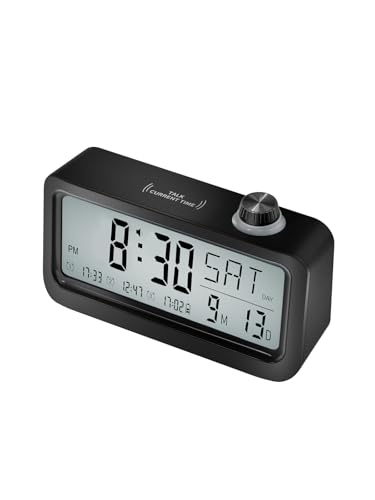
This Bovintex clock emphasizes personalized care with voice-recorded reminders, enabling caregivers to record messages in their own voice. It supports three reminders with adjustable volume and USB charging to avoid battery changes. The device is designed for medication and daily routine prompts, making it a practical choice for seniors who benefit from familiar voices and dependable power sources.
ORKA Talking Clock

ORKA’s talking clock is built with a large, high-contrast display and 8 customizable alarms. It supports recording personal messages and offers six language options, including English variants and several European languages. The device is AC-powered with a battery backup and a loud maximum volume, suited for users who need strong audio cues and multilingual support to accommodate caregivers or family members.
Buying Guide
Key considerations when choosing a digital talking alarm clock for seniors or dementia care:
- Auditory clarity and volume range: Look for devices with adjustable volume and clear speech to accommodate hearing loss.
- Display readability: Large digits, high-contrast text, and optional backlighting or auto-dimming reduce visual strain.
- Reminder features: Evaluate the number of alarms and reminders, especially for medications, meals, or appointments. Some clocks offer date and event reminders (birthdays/holidays).
- Power and reliability: USB charging or long-lasting batteries minimize maintenance. A backup power option is valuable during outages.
- Voice customization: Some models let you record personalized messages, which can improve memory cueing and comfort.
- Ease of use: One-button operation or minimal menus benefit users with cognitive or dexterity limitations.
- Language and accessibility: Multilingual support broadens usability for caregivers and family members across households.
- Size and placement: Consider bedside vs. table use, and ensure the device fits in the intended space without clutter.
- Durability and warranty: Check build quality and return policy to ensure long-term support for daily use.