For reliable off-grid living, selecting the right deep cycle storage battery is essential. This article highlights five top options that blend capacity, longevity, and safety for renewable energy storage, RVs, marine use, and home backup. Each pick emphasizes steady power delivery during deep discharges and maintenance‑free operation. Review the brief product summary table, then explore detailed sections with key features and practical considerations to help you compare approaches like AGM, LiFePO4, and traditional sealed designs.
| Product | Type | Capacity | Link |
|---|---|---|---|
| 8V (pair) | Trojan T875-AES | ||
| 100Ah | CHITOLI LiFePO4 | ||
| 200Ah | Renogy 200Ah AGM | ||
| 220Ah | Casil 6V 220Ah | ||
| 200Ah | Feuruetc LiFePO4 |
Trojan T875-AES 8V Deep-Cycle Battery Pair

The Trojan T875-AES 8V Advanced Energy Storage Deep-Cycle Battery delivers sealed, maintenance-free performance for off-grid solar setups, golf carts, marine, and industrial applications. Its Absorbed Glass Mat (AGM) design minimizes maintenance needs, water additions, and acid leaks. Built to endure vibration and demanding environments, this pair offers reliable energy storage for renewable systems and utility fleets.
CHITOLI 12V 100Ah LiFePO4 Battery

CHITOLI’s 12V 100Ah LiFePO4 battery is designed for long cycles and higher energy density, offering up to 15,000 cycles at 60% depth of discharge. A built‑in smart BMS guards against overcharge, over-discharge, over-current, and short circuits, making this a strong replacement for lead-acid systems in RVs, trolling motors, and home storage. Its compact weight and 100Ah capacity suit many off-grid configurations where space and efficiency matter.
Renogy Deep Cycle AGM 12V 200Ah

Renogy’s 12V AGM 200Ah battery emphasizes safe operation with a valve-regulated design that minimizes acid leaks and maintenance. Its low self-discharge rate and high discharge current make it suitable for extended off-grid runs and backup power. Renogy emphasizes compatibility for series and parallel configurations, supporting multi‑battery banks for larger energy needs, while prioritizing safety and simplicity in installation.
Casil 6V 220Ah Deep Cycle AGM

The Casil 6V 220Ah AGM battery delivers substantial capacity in a compact GC2 form factor. Its sealed, maintenance-free design reduces handling of corrosive fluids and supports indoor or outdoor installations. The 220Ah rating signals strong endurance for off-grid cabins, RV power systems, and floor-scrubbing equipment that require consistent voltage during deep cycles.
Feuruetc 12V 200Ah LiFePO4
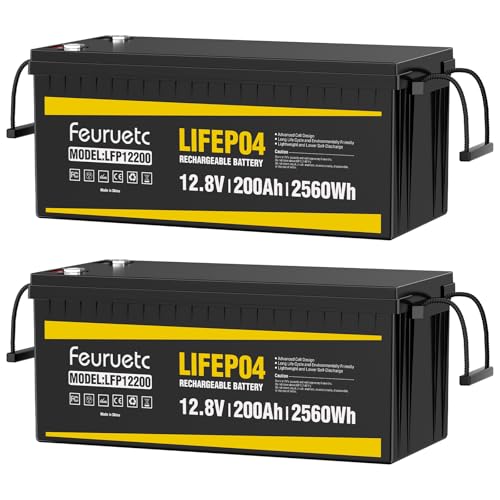
The Feuruetc 12V 200Ah LiFePO4 packs 200Ah with a built-in 200A BMS and a claimed 8000–15000 cycles, depending on depth of discharge. This battery aims at home energy storage and solar applications, offering a longer lifespan than typical lead-acid equivalents. Its safety features and robust protection mechanisms make it a compelling option for longer-duration supply needs in RVs and off-grid homes.
Buying Guide: Key Purchase Considerations
- Chemistry and cycle life: LiFePO4 (lifepo4) cells offer high cycle counts (thousands) and lower weight, but at a higher upfront cost. AGM provides maintenance-free operation with good durability and safer indoor use, often at a lower price point.
- Capacity and depth of discharge: Aim for higher usable capacity and consider DoD guidelines. LiFePO4 typically supports deeper DoD with longer life, while AGM batteries may have more limited long-term DoD.
- Voltage configuration: For off-grid systems, ensure compatibility with your inverter/charger. 12V and 6V packs can be configured in series/parallel to match system voltage and required capacity.
- Weight and space: LiFePO4 batteries are lighter and more compact, advantageous for RVs and marine use. AGM batteries are heavier but often more affordable per amp-hour.
- Maintenance and safety: AGM and LiFePO4 are generally maintenance-free. LiFePO4 offers robust thermal stability and safer chemistry, while AGM minimizes venting and leakage risks.
- Cycle life and warranties: Evaluate expected cycles under your DoD expectations and review manufacturer warranties. A longer warranty can indicate durable construction and better support.
- Charging tolerance and BMS: A smart BMS protects against overcharge, over-discharge, and short circuits. Confirm compatibility with your charger and any temperature management requirements.
- Operating environment: Temperature affects performance and lifespan. Some LiFePO4 cells perform better in cold conditions if managed properly; AGM can be sensitive to high heat.
- Expansion potential: If you plan to scale, choose batteries that allow safe serial/parallel configurations without complex rewiring or balancing.
These selections reflect a range of deep cycle technologies to suit different priorities: off-grid reliability, indoor installation safety, weight considerations, and lifecycle costs. When evaluating options, align battery chemistry and capacity with your energy profile, climate, and budget to optimize long-term performance and energy resilience.