When building or upgrading a CNC system, a reliable parallel port breakout board is essential for clean, accurate signal routing to stepper drivers. The products below are focused on parallel port control, MACH3 compatibility, and safety features like optical isolation to protect your computer and equipment. This guide compares five popular breakout boards and interface kits to help you choose the right fit for a DIY CNC or retrofitting an older machine.
| Product | Brand | Key Features |
|---|---|---|
| CNC4PC C10 Parallel Port Breakout | CNC4PC | EEE 1284 Standard compatible; input pull-up/pull-down; buffered I/O |
| Acxico 5 Axis CNC Interface Breakout | Acxico | Mach3 support; parallel port control; compact size |
| DAOKI Parallel Port 5-Axis Interface Board | DAOKI | Optical isolation; USB power; 12-24V input; multi-port control |
| KOOBOOK 5 Axis Breakout Board | KOOBOOK | Optical isolation; MACH3 support; 12-24V input; USB power |
| ViaGasaFamido MACH3 USB Interface Board | ViaGasaFamido | Optical isolation; 5-axis support; P1 port; USB power |
CNC4PC C10 Parallel Port Breakout
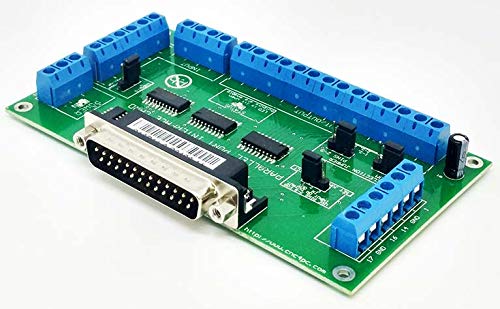
The CNC4PC C10 is a BI-Directional Parallel Port CNC Breakout Board designed for robust stepper control. It adheres to the EEE 1284 standard and offers configurable input pull-up or pull-down options to suit various wiring schemes. Buffered inputs and outputs improve signal integrity, reducing noise issues on aging parallel ports. This board is a strong choice for users seeking straightforward MACH3 compatibility with reliable I/O handling in a compact form factor.
Acxico 5 Axis CNC Interface Breakout

The Acxico breakout board supports MACH3 and other parallel port software for multi-axis CNC control. It emphasizes straightforward integration in small workspaces and provides a reliable interface for hobbyists and light industrial setups. The device is designed to map parallel port signals to multiple step and direction lines, enabling synchronized control for 5-axis configurations while maintaining a compact footprint.
DAOKI DC 12-24V CNC Interface Board

DAOKI’s 5-axis Mach3 interface board uses optical coupling to isolate input signals, including emergency stop, limit switches, and tool setting signals. It supports a wide power range (12-24V) and includes a one-way relay output for spindle control. The P17 port as an output and the ability to open all 17 ports provide flexible expansion, especially for systems requiring optocoupler-driven control of additional devices while maintaining computer safety through separate USB power and peripheral power supplies.
KOOBOOK 5 Axis Breakout Board

The KOOBOOK breakout board provides MACH3 compatibility and features isolated input signals via optical diaphragm to improve system security. It includes 12-24V support with a separated USB power supply and peripheral power, helping protect the computer from voltage spikes. The design accommodates emergency stop, tool setting, and limit signals, making it suitable for multi-axis CNC setups where isolated, reliable I/O is essential.
ViaGasaFamido MACH3 USB Interface

The ViaGasaFamido MACH3 USB Interface provides a USB-based solution with optical isolation on all inputs, helping to protect PCs from signal noise and electrical faults. It supports 5-axis operations and includes a P1 port for controlled outputs such as spindle speed. The board is designed to be compatible with MACH3 and other parallel-port software, and it separates USB power from the machine supply to improve safety and stability in mixed electrical environments.
New 2026 5 Axis MACH3 CNC Breakout

The 2026 5 Axis MACH3 breakout board emphasizes quality electronics and ease of installation. It is described as versatile for industrial, automotive, and household electronics applications, with a focus on compatibility with parallel port control. Users should verify MACH3 compatibility specifics and ensure the included USB cable and DB25 parallel cable meet their machine’s wiring schema.
Buying Guide
Key considerations when selecting a CNC parallel port breakout board include compatibility, isolation, voltage levels, and expansion options. Look for MACH3 or compatible software support to ensure smooth software integration and reliable step/direction signaling. Optical isolation or diaphragm-based isolation improves safety by protecting the controlling computer from electrical spikes and noise.
Signal integrity is important for accurate motion. Boards with buffered inputs/outputs and pull-up/pull-down configuration options help manage noisy environments. Power separation, such as dedicated USB power or separate peripheral power supplies, reduces risk to the computer and ensures stable operation in mixed voltage setups.
Physical footprint and port availability matter for compact CNC builds. Check how many axis you intend to drive, whether 3-, 4-, or 5-axis configurations are supported, and if expansion ports are accessible for future upgrades. For retrofits, ensure the board can adapt to legacy connectors and wire colors used in older machines.
Security and reliability are enhanced by optical isolation, emergency-stop wiring compatibility, and clear documentation. Compare installation complexity, included cables, and community support or vendor resources to estimate long-term usability. Finally, verify that the breakout board’s supported voltages (12-24V or similar) align with your spindle drivers and limit-switch circuits.