For makers, students, and engineers exploring digital signal processing on a budget, affordable development boards can unlock practical experiments without breaking the bank. This guide highlights five cost-effective choices that balance DSP capabilities with accessible tooling, tutorials, and expandability. Each option showcases either a capable DSP core, embedded DSP features, or FPGA-accelerated signal processing to help you prototype ideas quickly and affordably.
| Product | Brand | Key DSP/Development Feature | Link |
|---|---|---|---|
| Sipeed Tang Primer 20K | WayPonDEV | GW2A-LV18 core, high-performance DSP, LvDs interface, BSRAM, on-board DDR3/PMIC | View |
| ESP32 Development Board | DIYables | Dual-core MCU with WiFi/Bluetooth, USB-C, expansion board | View |
| STM32 Nucleo F446RE | STMicroelectronics | Cortex-M4 with DSP/FPU, 180 MHz, on-board ST-LINK | View |
| ADAU1452 DSP Board | Generic | Dedicated DSP with STM32F103, CODEC integration | View |
| Tang Nano 20K | UEEGO | GW2AR-18 FPGA, 20K LUT4, RISCV Linux, DSP units | View |
Sipeed Tang Primer 20K Gowin FPGA Board

The Sipeed Tang Primer 20K is built around the Gowin GW2A-LV18PG256C8I7 chip and designed for rapid DSP experimentation and hardware verification. This board emphasizes high-performance DSP capabilities, a fast LvDs interface, and integrated BSRAM alongside on-board DDR3 memory and a PMIC. It enables users to burn bitstreams from PicoRV/Litex to the GW2A and run RISC-V code, making it suitable for both DSP-focused and general hardware experiments. Its hardware design supports Verilog-based custom functions and C-language software running atop a PicoRV/Litex core.
Key considerations for this board include the need for familiarity with FPGA workflows, the availability of development toolchains for Verilog and RISC-V, and the suitability for projects requiring high DSP throughput in a low-cost package. It is well-matched for researchers exploring hardware acceleration, FPGA-based DSP pipelines, and quick verification of DSP algorithms in a single, compact board.
ESP32 Development Board With USB-C And Expansion
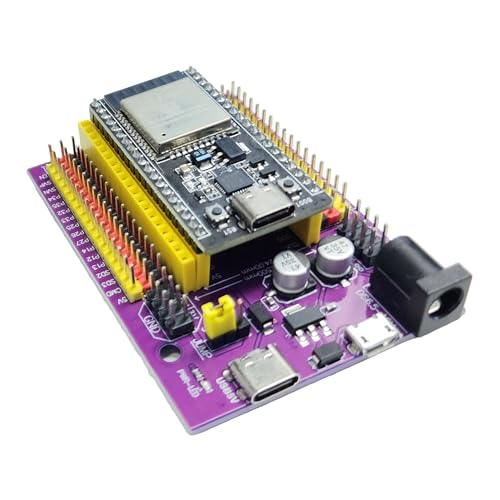
This combination package includes an ESP32 development board with USB Type-C and a 38-pin expansion board, offering a ready-to-prototype platform for IoT and embedded projects. The ESP-WROOM-32 module provides robust WiFi and Bluetooth connectivity, making it suitable for signal-processing tasks in connected devices, sensor networks, and smart applications. The CP2102 USB-to-serial interface supports reliable power and data communication for development workflows. While focused on IoT, the ESP32’s DSP-capable cores and extensive software ecosystem enable practical DSP experiments, such as filtering, spectral analysis, and real-time control, within a budget-friendly framework.
Pros include broad community support, easy Arduino IDE integration, and a flexible breakout board. Considerations involve the need to optimize for low-power operation in some DSP tasks and the board’s balance between performance and expandability depending on project goals.
STM32 Nucleo Development Board With F446RE

The STM32 Nucleo-F446RE combines a high-performance ARM Cortex-M4 core with digital signal processing capabilities and an FPU, running up to 180 MHz. With 512 Kbytes of flash, an ART accelerator, and dual QSPI, this board offers a solid DSP foundation for filtering, Fourier transforms, and real-time control tasks. The included ST-LINK/V2-1 debugger/programmer provides convenient USB-powered programming and debugging, enhancing the development workflow and reducing setup time for DSP experiments and embedded systems prototyping.
Ideal for engineers seeking a mainstream, well-supported DSP-enabled MCU with strong toolchain support (STCube and Keil). Potential drawbacks include reliance on ARM ecosystem and the need to manage memory and peripheral configurations for more demanding DSP workloads.
TMS320F2812 DSP Development Board Core

The TMS320F2812 DSP Development Board Core represents a traditional DSP hardware platform that emphasizes dedicated DSP processing with a focus on real-time signal processing tasks. This platform is suitable for learning and prototyping classic DSP algorithms, including filtering, spectral analysis, and fixed-point arithmetic. While potentially older in architecture compared with modern MCU/FPGA combinations, the F2812 remains a dependable option for specific DSP workloads and educational contexts after mastering its compiler and hardware interfaces.
Considerations for this board include the availability of modern development tools, compatibility with legacy DSP software, and the need to align with project requirements around fixed-point DSP performance and peripheral support.
ADAU1452 DSP Board With STM32F103

The ADAU1452 DSP board pairs a dedicated DSP with an STM32F103 MCU and CODEC integration, offering a compact solution for audio processing and DSP education. This setup is well-suited for projects involving digital audio processing, effects, filters, and real-time signal manipulation. The inclusion of a codec aids hands-on practice with audio pipelines, while the STM32F103 core provides general-purpose processing and control tasks.
Pros include a focused DSP audio environment, accessible software frameworks, and a straightforward hardware layout. Users should ensure compatibility with their software environment and verify driver availability for audio DSP development and control tasks.
Tang Nano 20K FPGA Development Board

The Tang Nano 20K from Sipeed uses the GW2AR-18 FPGA, delivering 20,736 LUT4 logic units and 15,552 registers. It includes onboard debugging via the BL616 chip with JTAG, USB-to-serial, and a virtual serial port for FPGA SPI and clock control. Running a RISC-V Linux environment, this board enables practical DSP workflows within an FPGA context, including hardware-accelerated signal processing and retro-gaming applications on a compact single-board computer. This option blends DSP-like acceleration with flexible software stacks for development and experimentation.
When selecting a Tang Nano, consider toolchain maturity, the learning curve of FPGA-based DSP, and the potential benefits of hardware-accelerated DSP versus MCU-based options for your use case.
Buying Guide: DSP on a Budget — Key Purchase Considerations
Budget-friendly DSP development boards vary widely in architecture, ecosystem, and intended use. The following perspectives help compare options and align with practical goals.
- Core architecture and DSP capabilities: Decide between MCU-based DSP (ARM Cortex-M4, ESP32) for task-driven signal processing, or FPGA/SoC approaches (GW2A, Tang Nano) for hardware-accelerated DSP. Consider required bandwidth, sampling rates, and real-time constraints.
- Development ecosystem and tooling: Favor boards with robust software support, active communities, and clear tutorials. Toolchain availability (IDE, compilers, libraries) impacts development speed and long-term viability.
- Memory and peripherals: Check memory size (RAM/Flash), available I/O, and audio interfaces if relevant. On-board memory and codecs simplify prototyping; expandability matters for larger projects.
- Power and form factor: If your project is portable, assess power consumption and battery compatibility. Smaller boards are convenient for prototypes but verify that peripherals meet your needs.
- Community examples and documentation: Access to example projects, reference designs, and DSP demonstrations reduces ramp-up time and clarifies best practices for your use case.
- Future-proofing and upgrade paths: Consider whether the board offers straightforward pathways to more capable platforms if your project scales, such as migrating from MCU-based DSP to FPGA acceleration or Linux-capable SoCs.
In practice, for quick DSP prototyping on a budget, boards combining a capable DSP-enabled MCU (like STM32F4 series or ESP32 with DSP-friendly cores) with clear documentation tend to deliver reliable results. FPGA-based boards provide powerful hardware acceleration but require more learning and tooling, which may be worthwhile for complex signal-processing pipelines. Audio-focused boards with integrated CODECs streamline test setups, whereas general-purpose boards excel for multi-purpose development with DSP as a feature rather than the primary focus.