Finding a portable, battery-powered Bluetooth serial adapter can simplify connecting legacy RS232 and RS485 devices to modern smartphones, tablets, or PCs. This guide highlights five top options that blend wireless versatility with built-in power, so you can debug, monitor, or control equipment on the go. Each pick supports RS-232 or RS-485 interfaces, offers battery or USB power, and includes a Bluetooth module for easy pairing. Below is a concise product snapshot to help you compare core specs quickly.
| Product | Brand | Key Benefit |
|---|---|---|
| CP26 RS232 to Bluetooth (Device) | PDDAXLQUE | Built-in 5.1 BLE, long-range wireless, internal battery |
| CP26 RS232 to Bluetooth (PC) | PDDAXLQUE | Compact, USB/Battery power, easy RS232 wireless |
| DSD TECH SH-B23A Bluetooth 2.0 to RS232 | DSD TECH | Industrial Bluetooth 2.0 SPP, broad device compatibility |
| DSD TECH SH-B35 RS485/RS232 to Bluetooth | DSD TECH | Dual-mode RS485/RS232, Android/Windows support |
| WAVARCL WF610 Pro Bluetooth RS232/RS485 | MATOLUO | RJ45/DB9 compatibility, long wireless range |
CP26 RS232 to Bluetooth (Device) — Battery-Powered

The CP26 device converts RS232 interfaces into wireless Bluetooth communication, enabling PCs, iOS, and Android devices to exchange data with wired equipment. It uses a built-in Renesas Bluetooth 5.1 BLE module and includes an external antenna for improved range. A rechargeable lithium battery allows up to 24 hours of operation without external power, with charging via USB-C. Supported distances vary by host device: around 90 meters to a mobile phone, 70 meters to a PC, and up to about 400 meters device-to-device in open space. This model is ideal for field debugging and parameter querying of RS232 devices.
Key features include Bluetooth 5.1 BLE, a long-distance visual range, and a compact power package. The unit supports wireless communication with RS232 devices, making it suitable for engineering setups, parameter configuration, and information retrieval tasks where wired connections are impractical.
CP26 RS232 to Bluetooth (PC) — Battery Option

This CP26 variant targets PC-centric use, enabling wireless RS232 communication with Android or iOS devices. It ships with a built-in battery and USB power by default, with a selectable BAT mode for mobile operation. Note: direct PC connections may require a CP11-Master module from the same brand. The device emphasizes ease of use, stability, and flexible deployment in environments where a wired RS232 link would otherwise require a cable run or a stationary power source.
DSD TECH SH-B23A Bluetooth 2.0 to RS232
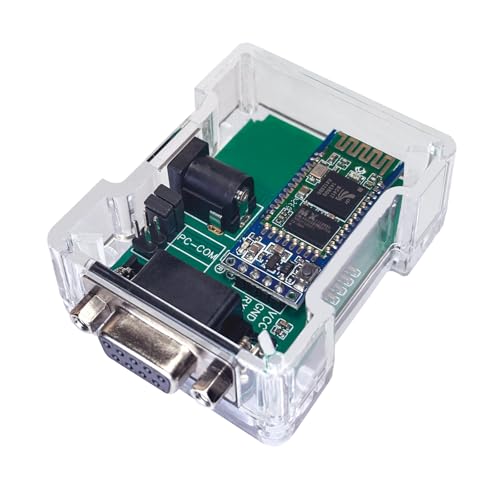
The SH-B23A from DSD TECH provides a straightforward Bluetooth 2.0 SPP connection for RS232 devices. Its CSR BC417-based module ensures compatibility with Android devices and Bluetooth-enabled computers, while not supporting iOS. The DB9 interface supports essential Tx/Rx signaling, though hardware flow control lines CTS/RTS are not supported. This option emphasizes simplicity and broad device compatibility for non-iOS ecosystems, suitable for maintenance and data-collection tasks where quick pairing matters.
DSD TECH SH-B35 RS485/RS232 to Bluetooth

The SH-B35 adds RS485 capability to the Bluetooth bridge alongside RS232. This makes it suitable for more complex industrial networks that require multi-drop devices or differential signaling. The device uses a Bluetooth 2.0 SPP stack and is compatible with Android and Windows platforms. It’s positioned for engineers who need wireless access to mixed serial networks and straightforward pairing without driver installation.
WAVARCL WF610 Pro — Bluetooth RS232/RS485

The WAVARCL WF610 Pro from MATOLUO supports RS232 over Bluetooth with DB9-to-RJ45 configurations for console management. It focuses on long-range wireless operation, broadband OS compatibility (Windows, Mac, Linux, Android), and configurable baud rates up to 256000. The device is well-suited for network equipment management, remote console access, and industrial environments requiring a reliable wireless serial link with adjustable parameters and robust OS support.
Buying Guide: Key Considerations For Choosing A Battery-Powered Bluetooth Serial Adapter
When selecting a Bluetooth serial adapter that runs on battery power, several factors determine performance and fit for your use case. Consider these perspectives to balance portability, compatibility, and reliability:
- Interface compatibility: Confirm RS232 vs RS485 support and the available connector types (DB9, RJ45, etc.). If you need both RS232 and RS485, look for models that explicitly offer dual-mode support or clear upgrade paths.
- Power design: Evaluate battery type, expected runtime, and charging method. Some models ship with built-in lithium batteries and USB-C charging; others offer USB-powered operation with a battery switch option for mobile use.
- Bluetooth version and range: A higher BLE version improves pairing stability and power efficiency. Long-range performance depends on antenna quality and device class; verify typical host distances in practical scenarios.
- Device compatibility: Check OS support (Android, iOS, Windows, macOS, Linux). Note iOS limitations on certain Bluetooth SPP devices, which can affect native app connections.
- Power management: Look for auto-reconnect, configurable baud rates, and PIN/code settings. Software-configurable parameters can simplify integration with existing systems.
- Ease of use: Consider plug-and-play capability, whether drivers are needed, and how the device handles pairing and re-pairing after power cycles.
- Industrial vs consumer grade: For field deployment, prioritize rugged builds, voltage tolerance, and robust connectors to withstand environmental conditions.
- Documentation and support: Access to clear manuals, example wiring diagrams, and firmware updates can shorten deployment time and reduce troubleshooting.
In practice, choose a model that aligns with your target host devices, required range, and the specific serial protocol you rely on. For fieldwork, a battery-powered CP26 variant with a built-in 5.1 BLE module offers a strong balance of range and portability. For mixed industrial environments, SH-B35 or WAVARCL WF610 Pro provide broader signaling support and OS compatibility. Always verify that the product’s advertised features match your exact use-case constraints before purchasing.