Choosing the right attendance monitoring system helps businesses track work hours, automate payroll, and enforce attendance policies. This guide reviews five prominent options, highlighting how each one can fit different business sizes—from small teams to growing organizations. See practical features, ease of setup, and how they support real-time monitoring and recordkeeping.
Summary of Selected Products:
| Product | Brand | Key Benefit |
|---|---|---|
| uAttend BN6000 | uAttend | Biometric time tracking with cloud access |
| TimeTrax Elite | Pyramid Time Systems | Proximity-based punch with no-touch option |
| VistaRise Attendance Calendar | VistaRise | Binder-ready tracking calendar for manual logging |
| 2026 Employee Attendance Cards | NextDayLabels | Compact 2026 tracking cards, USA-made |
| 2026 Attendance Calendar Pack | S Superfine Printing | Colorful, durable attendance calendar for 2026 |
uAttend BN6000 Biometric Time Clock System

The uAttend BN6000 integrates biometric fingerprint scanning for precise punch capture, helping prevent buddy punching and improving attendance accuracy. It provides cloud access for real-time monitoring, with LAN connectivity and automatic backups to protect attendance data. Setup is described as easy, featuring an intuitive interface and USA-based support to assist with quick installation. This solution is suitable for small to mid-sized teams seeking secure, verifiable time records and centralized data access.
TimeTrax Elite Automated Proximity Time Clock

The TimeTrax Elite supports proximity badge-based punch-in, enabling non-contact time tracking. It tracks arrivals, breaks, lunches, overtime, and departures to deliver real-time attendance monitoring that aims to streamline operations. The system includes payroll editing, reporting, and exporting software with no subscription fees, offering dependable payroll control. It supports up to 50 employees with included badges and can scale via software upgrades and additional badges, making it adaptable for growing teams.
VistaRise 2026 Attendance Calendar
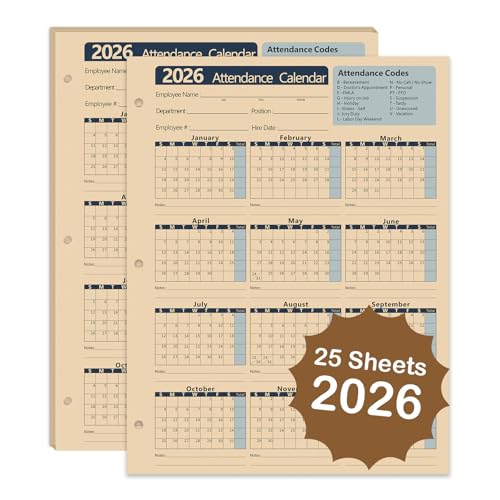
The VistaRise 2026 Attendance Calendar is a binder-ready tracking tool printed on thick card stock. It uses a simple coding system for recording leave times, absence reasons, and the number of excused or unexcused days. With three-hole punches for standard binders, it offers a straightforward, low-tech approach suitable for organizations that prefer manual attendance records or need a supplementary audit trail for compliance and HR processes.
NextDayLabels 2026 Employee Attendance Cards

NextDayLabels offers a 2026 calendar-style attendance work record in card form. Each pack contains 25 sheets, printed on heavy white stock with green ink and three-hole punched for use in three-ring binders. The layout supports quick recording of employee names, departments, and daily attendance. The back features extra lines for notes, making it useful for documenting additional attendance details or notes about specific days.
2026 Attendance Calendar – Great Employee Daily Tracker

This 2026 attendance calendar emphasizes bright, color-coded daily tracking on durable 80 lb cover cardstock with a 3-hole punch for binder integration. It provides space for employee name, department, and year-specific tracking, plus extra lines for notes on absences or attendance warnings. The vibrant design supports quick visual reviews and helps managers monitor patterns at a glance.
Buying Guide: Key Purchase Considerations
- Implementation scale: Assess whether a biometric, badge-based, or manual calendar system best fits your team size and workflow. Small teams may prefer simple calendars or card-based logs, while larger organizations benefit from automated time clocks with cloud syncing.
- Data integrity and security: Biometric options reduce buddy punching but require secure handling of biometric data. Cloud-enabled systems offer real-time access but require robust network reliability and data backups.
- Integration with payroll and HR: Look for software that exports payroll data, supports standard formats, and integrates with existing HR systems to minimize manual data entry.
- Ease of use and support: Consider the setup complexity and whether vendor support is US-based or offers remote assistance. Training and documentation can shorten the onboarding period.
- Hardware vs. manual records: A hybrid approach can balance cost and accuracy. Pen-and-paper calendars are low-cost but require meticulous maintenance, while electronic systems automate calculations and reporting.
- Future scalability: If growth is anticipated, choose solutions with scalable licensing, additional badges or time terminals, and expandable software features to avoid frequent replacements.
- Compliance considerations: Ensure the system supports audit-ready records and adheres to local labor regulations regarding timekeeping, overtime, and leave management.
Across these options, organizations can prioritize accuracy, accessibility, and cost-effectiveness. Biometric and proximity-based systems emphasize real-time data and security, whereas calendar-based tools emphasize simplicity and physical records. By aligning the choice with company size, payroll processes, and compliance needs, employers can select an attendance monitoring solution that improves workforce efficiency and accuracy over time.