Choosing an amplifier that can drive multiple speakers reliably is essential for multi-room music, outdoor parties, or home theater systems. The following selections are designed to handle more than one speaker channel, offer various input options, and provide solid amplification without excessive noise or distortion. Each option below comes with multiple input modes, zone controls, or bridgeable channels to help you tailor the sound to different spaces and uses.
Product Overview
Summary Table of Selected Products:
- Pyle 4 Multi-Zone Stereo Amplifier – PT8000CH: 8000 Watts total, 4-channel with volume control and bridgeable options for multi-room setups.
- Rockville RCS80-1 Bundle: 60W per zone 70V commercial amp with 8 ceiling speakers and zone control for restaurants or offices.
- Fosi HT4S Bluetooth Amplifier: 4-channel outdoor/indoor amp with Bluetooth, AUX, optical inputs and multi-room versatility.
- Viprh 2000W Stereo Amplifier: 400W RMS per channel, multiple inputs, mic options, suitable for home theaters and parties.
- MUSYSIC SYS-4500: 4500W peak, 2-channel professional amp with advanced DSP/ATR technology for DJs and live setups.
This article focuses on amplifiers that excel when powering more than a single pair of speakers, whether you’re wiring a home theater with multiple zones, a party setup with distributed sound, or a small business environment requiring clear, controllable audio across areas.
Pyle 4 Multi-Zone Stereo Amplifier PT8000CH

The Pyle PT8000CH is a versatile multi-zone amplifier designed for larger, connected systems. It features eight channels of high-power amplification with four-zone speaker binding posts and the ability to pair channels for bridgeable use. The unit supports daisy-chaining and has a clear LED level display to help monitor audio output across zones. Built for commercial or home use, it is compatible with a range of sources, including Bluetooth and analog inputs, allowing flexible integration into existing setups. Its multi-room focus makes it a strong candidate for restaurants, retail spaces, or private residences seeking synchronized playback.
Key capabilities include: 8000W total power with 60W per channel configurations, multiple input options, and built-in bridging for higher power where needed. Setup may require careful impedance management when running multiple zones, but the flexible routing supports complex distributions without sacrificing sonic clarity.
Rockville RCS80-1 60W 70V Commercial Amplifier Bundle

This Rockville bundle targets commercial spaces that require zone-based amplification with simple wiring. The RCS80-1 delivers 60W RMS per zone on a 70V system, which simplifies long runs and speaker matching in restaurants, offices, or classrooms. The system includes eight 6″ white ceiling speakers, a wall volume controller, and the amplifier with Bluetooth, USB/SD inputs, and dual mic inputs—handy for announcements or karaoke. Because of its commercial design, it emphasizes reliable, repeatable sound distribution across multiple zones with consistent levels.
The bundling approach reduces integration complexity: long wire runs are more feasible with 70V, and the zone controller makes it straightforward to tailor levels for each area. Potential considerations include ensuring compatible speaker taps and managing headroom for peak events. It’s well-suited for installations where predictable coverage and ease of maintenance matter most.
Fosi HT4S Bluetooth Amplifier

Fosi HT4S is an all-in-one stereo amp that supports up to 5 channels and blends Bluetooth streaming with traditional inputs. It’s compact enough for desktop or small patio setups while offering 4.1 or 5.0 channel configurations, which is useful for multi-room or outdoor installations where space is a constraint. Inputs include Bluetooth, AUX, and optical, with pre-out for external subwoofers or additional amplification. This flexibility makes it appealing for home theaters, cafes, or small venues seeking a streamlined, multi-source amplifier experience.
Considerations include the lack of built-in surround processing and the need to verify power delivery to all channels in larger outdoor configurations. Still, the HT4S excels in versatility, portability, and ease of use, particularly where quick setup and Bluetooth streaming are priorities.
Romicta Stereo Amplifier KS-33BT: 2 Channel 500W
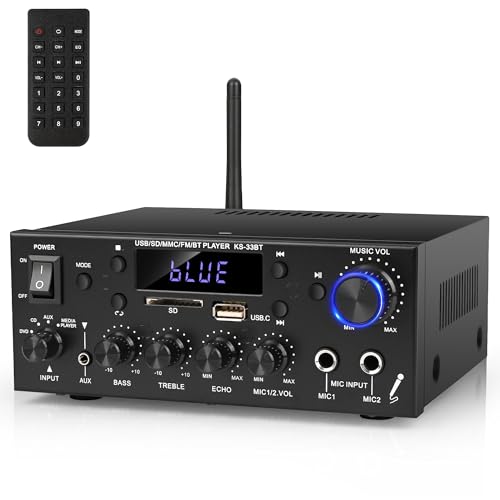
Romicta’s KS-33BT offers a robust two-channel solution with high power and multiple input options, including Bluetooth 5.0. While it’s fundamentally a two-channel unit, its dual-input ports and compatibility with passive speakers plus an active subwoofer make it a flexible core for compact multi-device setups. It’s particularly suitable for home theaters, bedrooms, or small music rooms where strong amplification is needed without a large multi-zone footprint.
Highlights include a 500W peak output per channel, dual input versatility, and a design that fits compact shelves. For multi-speaker configurations, this amp can be paired with a separate zone controller or additional amps to create distributed audio across rooms, though it may require careful planning to maintain synchronized output in a multi-room installation.
MUSYSIC SYS-4500 Professional Power Amplifier

The SYS-4500 is designed for serious audio environments, delivering 4500W peak power across two channels. ATR Technology helps control fast bass transients, reducing distortion at high output and enabling impactful performances for DJs, live events, or professional installations. The amplifier supports a range of input/output configurations and is compatible with CVR amplifier systems for expanding multi-channel setups. Its robust build and digital processing cater to demanding audio tasks where clear, loud, and precise sound is essential.
Practical considerations for multi-speaker use include ensuring adequate ventilation for sustained power, checking impedance compatibility with connected speakers, and planning for heat management in rack-mounted installations. The SYS-4500 stands out for large-scale or high-demand environments where peak performance and reliability are critical.
Buying Guide: Key Purchase Considerations for Multi-Speaker Amplifiers
- Power and headroom: Assess total watts per channel and the expected load from all connected speakers. Larger spaces or outdoor setups benefit from higher power ratings and the ability to bridge channels when needed.
- Channel configuration and zoning: Multi-zone or multi-channel designs enable separate volume control and source distribution across rooms. Consider whether your space needs 2, 4, 6, or more independent zones.
- Input and output options: Look for Bluetooth, AUX, USB/SD, optical, mic inputs, and pre-outs for subwoofers or additional amps. Compatibility with existing devices reduces wiring complexity.
- System integration: 70V vs. low-impedance (8-Ohm, 4-Ohm) outputs affect how far signals can travel and how many speakers you can drive. Choose based on speaker type and installation scale.
- Audio quality and clarity: Features like ATR processing, DSP, and low THD help maintain fidelity at higher volumes. Consider cooling, build quality, and reliability for longer-term use.
- Form factor and installation: Rack-mountable options, wall-mounted controllers, and size/weight influence installation in homes, cafes, or offices. Outdoor-rated enclosures may be required for patios and pools.
- Budget and scalability: Start with a supported core setup and plan for future expansion with additional amps or zone controllers. Bundles can simplify installs but verify compatibility with your speakers.
- Maintenance and support: Look for common-sense warranty terms and readily available replacement parts or service options to minimize downtime in commercial environments.
Across these picks, a recurring strategy is to match the amplifier’s zones or channels to your physical layout, then align power and impedance to the speaker loads. If you’re unsure about impedance, speaker wattage, or wiring, consult an audio professional to design a system that remains within safe electrical limits while delivering the desired coverage and volume.