Discover reliable 8-channel servo controllers and versatile multi-channel PWM driver boards that suit Arduino, Raspberry Pi, and DIY robotics projects. This guide highlights top 8-channel options and compatible multi-channel controllers, focusing on performance, protection features, and ease of use. Each product section provides a quick overview, key specs, and practical use cases to help you choose the right controller for your application.
| Product | Brand | Channels | Key Benefit |
|---|---|---|---|
| Yahboom RC Servo Tester 8 Channels | Yahboom | 8 | Independent channels with over-current protection |
| HiLetgo PCA9685 16 Channel PWM Driver | HiLetgo | 16 | IIC interface, scalable for many servos |
| Teyleten Robot PCA9685 16 Channel | Teyleten Robot | 16 | I2C control, 12-bit resolution |
| Treedix 6-Channel RC Servo Tester | Treedix | 6 | Real-time display and multi-mode control |
| Digital 8 Channel Servo Controller Board | Goodstumbler | 8 | Over-current protection and high-precision PWM |
Whether you are prototyping a multi-servo robotic arm, building a remote-control aircraft, or creating an animatronic display, these controllers offer scalable channels, protective features, and reliable PWM performance. The following sections describe each option in detail to help you select the best fit for your project needs.
Yahboom 8-Channel Servo Tester
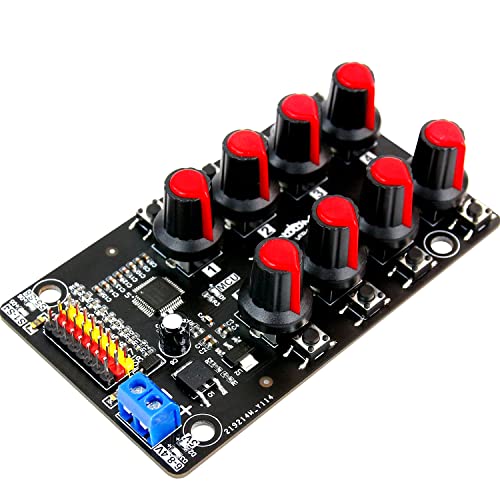
The Yahboom 8-channel servo tester provides independent servo interfaces with eight high-precision potentiometers for manual adjustments. It supports two control modes—manual and centering—and enables switching between modes via function keys. A 5-8.4V terminal block power supply port powers all channels, and over-current protection helps safeguard connected servos. Compatible with standard 5V-8.4V servos, this controller is well-suited for hobby robots, RC hobby projects, and lab experiments requiring precise, multi-servo control.
HiLetgo 16-Channel PCA9685 PWM Driver

The HiLetgo PCA9685 module offers a 16-channel, 12-bit PWM servo driver via IIC interface. It operates on a DC 5-10V power supply and is designed for Arduino and other microcontroller platforms. This board allows independent servo control across multiple channels, making it ideal for larger projects that require synchronized or complex servo movements without tying up your primary microcontroller’s resources.
Teyleten Robot PCA9685 16-Channel Driver

The Teyleten Robot PCA9685 module provides 16-channel PWM control via I2C input. It enables control of multiple servos (16 outputs) using just two pins, with a frequency range of 40-1000Hz and 12-bit resolution. This makes it a flexible choice for robotics projects on platforms like Arduino and Raspberry Pi, offering scalable servo deployment with reliable performance.
Treedix 6-Channel RC Servo Tester

The Treedix RC Digital Servo Tester features a high-precision potentiometer for real-time servo control and a real-time LCD display showing current servo position and operating voltage. It supports three control modes: Control Mode (adjust angle via potentiometer), Lock Mode (angle locked), and Center Mode (servo at neutral position). An onboard 8-bit microcontroller ensures dependable control accuracy, making this device suitable for RC cars, planes, and robotics testing where quick, precise feedback is needed.
Digital 8-Channel Servo Controller Board

This 8-channel digital servo controller offers precise control with high-quality PWM signals, and built-in over-current protection to safeguard servos during extended operation. Its 0.09° high-precision PWM performance supports smooth movements in multi-servo configurations, making it a strong option for robotics projects, animatronics, and drone gimbal systems that demand reliable, jitter-free servo control with protection features.
Buying Guide: Key Considerations For 8-Channel And Multi-Channel Servo Controllers
- Channel count and scalability: If you plan to expand beyond 8 channels, look for boards that support 16 channels via I2C, PWM drivers, or multi-board chaining. Consider how many servos you will run concurrently and whether you need independent control per channel.
- Voltage and power: Check the operating voltage range (commonly 4.8–6V or 5–10V). Ensure your servo power supply can handle peak currents, especially when several servos move simultaneously. Some boards include a separate power port for high-current motors to protect microcontrollers.
- Control interface: I2C/IIC interfaces save processor bandwidth for microcontrollers, allowing many servos to be driven with minimal CPU load. Some boards also offer direct PWM or serial control, so match the interface to your system.
- Resolution and precision: PWM resolution (often 12-bit) determines how smoothly servos respond to position changes. Higher resolution reduces jitter and improves precision in robotics applications.
- Protection features: Over-current protection, thermal protection, and short-circuit safeguards extend servo life and prevent damage to controllers. These features are especially valuable in learning environments and long-duration experiments.
- Ease of integration: Look for libraries and documentation compatible with your platform (Arduino, Raspberry Pi, ESP32). Clear wiring diagrams and example codes reduce development time.
- Physical form factor and wiring: Consider the board size, connector spacing, and ease of wiring. Some modules provide terminal blocks for simpler power connections, while others use standard 0.1″ headers.
- Price-to-performance balance: For hobbyists, a balance between affordability and functionality is key. A board with essential protections and sufficient channels often yields the best long-term value.
In selecting an 8-channel servo controller, prioritize your project’s voltage needs, required control interface, and whether you expect to scale to more servos. For compact setups, a dedicated 8-channel tester like the Yahboom device can be ideal for quick testing and adjustment, while multi-channel PCA9685 modules provide scalable options for larger robotic systems. Always verify compatibility with your servos and microcontroller platform before purchasing.