The 5V, 100mA class of solar panels is ideal for educational kits, small DIY projects, and hobby electronics. This guide highlights five compact panels that can power tiny devices, charge small batteries, or run solar-powered displays. Each option includes practical notes on usage, durability, and connection tips to help makers maximize performance in sun, shade, or indoor setups.
Summary of chosen products:
| Product | Voltage | Current | Size | Best For |
|---|---|---|---|---|
| Sunnytech 0.5w 5v 100ma Mini Solar Panel Module | 5V | 100mA | Compact | Educational projects, small toys |
| MECCANIXITY 2 Pcs Mini Solar Panels 5.5V 0.55W 100mA | 5.5V | 100mA | 70mm x 70mm | DIY kits, displays |
| uxcell 5Pcs 0.5V 100mA Mini Solar Panels | 0.5V (per panel) | 100mA | 53mm x 18mm | Low-power charging, experiments |
| Sunnytech 1.25w 5v 250ma Mini Solar Panel Module | 5V | 250mA | Compact | Higher output experiments |
| FellDen 5V Micro Panels Kit 10-Pack | 5V | 200mA | 110mm x 60mm | Multiple-project kits |
All panels feature epoxy encapsulation for durability and color-coded wiring for easy wiring. When selecting, consider voltage range, current needs, panel size, and the type of solar cells (polycrystalline vs monocrystalline) to match your project’s light conditions and energy goals.
Sunnytech 0.5w 5v 100ma Mini Solar Panel Module

This compact panel provides up to 0.5W at 5V and 100mA, suitable for simple solar-powered toys, small displays, and educational experiments. The panel uses epoxy encapsulation for durability in wind and snow and includes color-coded wires with alligator clips for quick setup. A blocking diode is pre-installed to protect against overcharging and backflow, making it safer for beginners and classrooms.
FellDen Micro Solar Panels Kit 5Pcs 5V 200mA

Each 110mm by 60mm panel delivers about 200mA at 5V, great for small solar-powered lights, pumps, or science projects. The kit contains five panels with wiring suitable for parallel or series configurations, enabling increased current or voltage as needed. These panels are wind and snow resistant and can be used outdoors or in bright indoor settings.
uxcell 5Pcs 4V 100mA Poly Mini Solar Cell Panel

This set provides five small polycrystalline panels, each rated around 4V and 100mA, suitable for charging tiny batteries, powering sensors, or science demonstrations. The compact 70mm x 70mm footprint makes them useful for portable projects, DIY toys, and experiments that require multiple panels in parallel or series configurations for different voltage/current requirements.
Sunnytech 1.25w 5v 250ma Mini Solar Panel Module

Offering higher output than the smaller Sunnytech panel, this 1.25W module can power modest devices, science kits, or microcontrollers in brighter conditions. It features epoxy-based construction, two solder tabs for permanent connections, and a pre-installed blocking diode. This panel aligns well with projects that require steadier power delivery and longer operation between charges.
KEJNYT 5Pcs 1W 5V 200mA Solar Panels Kit
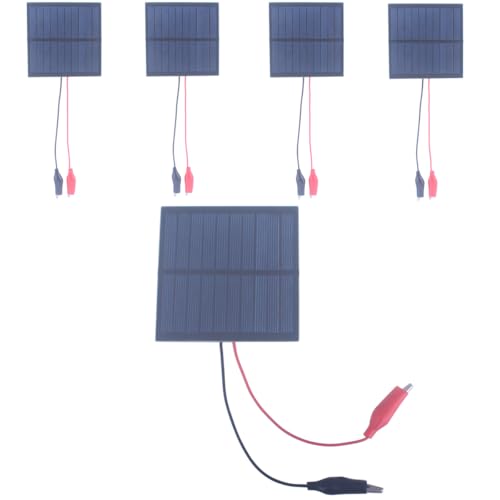
Each panel is rated 1W at 5V, providing up to 200mA. The package includes five panels with wire and clip connections, enabling easy parallel or series wiring without soldering. It’s suitable for DIY electric toys, small displays, or educational experiments where a modest power source is helpful for demonstrating solar charging and energy storage concepts.
FellDen 5V Micro Panels Kit 10Pcs

This ten-pack provides multiple panel options for larger Maker projects. Each panel is designed for low-power DC applications, scientific projects, or small solar-powered devices. The set’s diversity allows experimenting with series and parallel configurations to explore voltage and current trade-offs under varying light conditions.
Buying Guide: Key Considerations For 5V, 100mA Class Panels
- Voltage and current requirements: For most small projects, target devices that run on 5V or near-5V with current draw under or around 100mA. If your device needs more current, consider parallel panel configurations or higher-output panels.
- Panel size and form factor: Compact panels are ideal for portable experiments and education kits; larger panels deliver more current but require more mounting space and exposure to light.
- Cell type and efficiency: Polycrystalline cells offer good cost-performance for DIY projects, with reasonable efficiency. Monocrystalline cells can provide higher efficiency in shaded conditions but may come at a higher price.
- Durability and enclosure: Epoxy-encapsulated panels resist wind and moisture better, which is beneficial for outdoor use. Look for weather-resistant designs if outdoor exposure is common.
- Wiring and connectors: Panels with pre-attached wires and clip connectors simplify quick testing. Panels with solder tabs enable permanent connections for more permanent builds.
- Diodes and protection: Pre-installed blocking diodes help prevent backflow and overcharging, improving panel safety in charging applications.
- Use case compatibility: For education and demonstrations, kits with multiple panels allow experimentation with series/parallel configurations. For actual charging tasks, ensure the panel’s voltage plus controller meets your battery’s requirements.
- Ambient light conditions: In indoor or low-light environments, performance drops. If your project will run indoors, consider using panels with higher efficiency or supplement with ambient lighting.
- Cost vs. quantity: Multi-pack options offer value for classroom sets and hobby projects, enabling more experiments without a high price per panel.
Choosing the right panel involves aligning your device’s power needs with the panel’s output under real-world light. When testing, measure voltage and current in your setup to confirm compatibility and avoid overloading batteries or electronics.