If you’re building or upgrading a small DIY speaker system, a reliable 5-watt stereo amplifier can make a big difference in sound clarity and power efficiency. This guide highlights five well-regarded 5W-class amplifier boards that are popular for compact setups, including Class D designs and Bluetooth-enabled modules. Each option emphasizes low noise, good thermal performance, and straightforward integration with common power sources like 5V DC supplies. Read on to compare features, compatibility, and practical use cases for hobbyists and tinkerers alike.
The following table offers at-a-glance details for the selected products to help you quickly compare specs and typical use scenarios. Note that all products are intended for DIY audio projects and require appropriate enclosure, wiring, and safety considerations.
| Product | Brand | Power Output | Power Supply | Key Strength |
|---|---|---|---|---|
| DROK 5W+5W Mini Audio Amplifier Board PAM8406 | DROK | 5W (2Ω 5V); 3W (4Ω 5V); 1.8W (8Ω 5V) | DC 5V | High efficiency; compact board |
| Audio Amplifier Board, Icstation Ḅḷụẹ-ṭောṭḥ-Compatible | IS | 5W+5W dual channel | 3.7V–5V (recommended 3.7V lithium battery) | BT 5.0 plus anti-cracking and subwoofer support |
| DROK 5W+5W Mini Amplifier Board (2pcs) | DROK | 5W (2Ω 5V); 3W (4Ω 5V); 1.8W (8Ω 5V) | DC 5V | Two-board kit; high efficiency |
| HiLetgo CT14 Stereo Bluetooth Amplifier Board | HiLetgo | 5W+5W | 5V | BT 5.0 compatible; plug-and-play |
| DiGiYes PAM8406 5W+5W Mini Amplifier Board | DiGiYes | 5W (2Ω 5V); 3W (4Ω 5V); 1.8W (8Ω 5V) | DC 5V | Low quiescent current; fault protection |
DROK 5W+5W PAM8406 Mini Audio Amplifier Board

The DROK PAM8406-based amplifier board operates at DC 5V and delivers up to 5W into a 2Ω load, with 3W into 4Ω and 1.8W into 8Ω. It uses a compact immersion gold circuit board and premium capacitors, including KEMET speaker capacitors, to minimize noise and thermal buildup. With a claimed efficiency above 90% and relatively low harmonic distortion, this module suits compact DIY speakers and portable sound projects where a small footprint is essential.
Icstation Ḅḷụẹ-ṭọọṭḥ-Compatible 2x5W Bluetooth Amplifier Board

Icstation’s amplifier board is designed for 3.7V to 5V operation and supports Bluetooth 5.0 connectivity, with a typical output of 5W per channel when connected to suitable speakers. The design emphasizes a clean signal path with attention to interference reduction and stable pairing with Bluetooth devices. The board accommodates 2–8 ohm speakers and can be integrated into small Bluetooth-enabled speaker projects or retrofitting single-board audio rigs with wireless inputs.
DROK 5W+5W Mini Amplifier Board (Two-Pack)
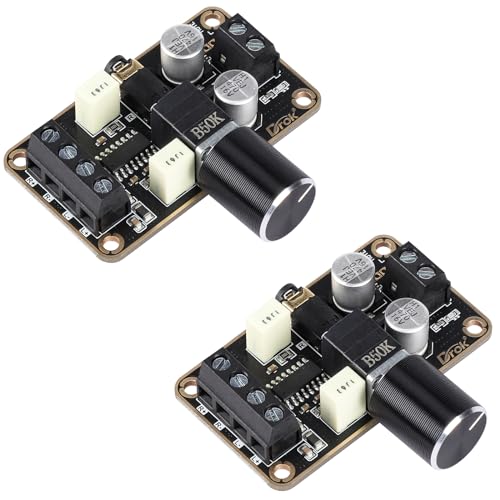
This two-pack kit mirrors the single-board DROK PAM8406 design, offering two independent 5W channels for stereo configurations or multi-speaker setups. As with the single-board version, it features a 5V DC power supply, high efficiency, and low noise performance suitable for compact DIY audio projects. The dual-pack can help create a balanced stereo system with consistent performance across channels.
HiLetgo CT14 Stereo Bluetooth Amplifier Board

HiLetgo’s CT14 module is a Bluetooth-enabled stereo amplifier that delivers 5W per channel at 5V, with a Class F design to optimize efficiency. It supports automatic device pairing, USB sound card compatibility, and plug-and-play operation. This board is well-suited for quick Bluetooth speaker builds or upgrades to add wireless playback without needing separate DACs or additional circuitry.
DiGiYes PAM8406 5W+5W Mini Amplifier Board

DiGiYes offers a PAM8406-based amplifier board with 5W per channel output, low quiescent current, and robust protection features including short-circuit, thermal, and reverse protection. The design focuses on efficient power use and reliable operation, making it a practical choice for portable speakers, educational kits, and compact audio projects where steady performance matters.
Buying Guide
Key purchase considerations help ensure you select the right 5W stereo amplifier for your project:
- Power and load compatibility: Check the rated output (5W per channel is common for 2Ω and 4Ω loads) and ensure your speaker impedance matches the board’s recommendations to avoid clipping or overheating.
- Power supply and efficiency: Most 5W boards run on 5V DC. If your enclosure uses a battery, confirm voltage stability and capacity to minimize noise and interference.
- Bonding and inputs: Look for boards with easy wiring, robust input connectors, and compatibility with mono or stereo inputs. Bluetooth-enabled boards offer wireless convenience but may introduce latency or codec considerations.
- Noise, distortion, and protection: Boards with low quiescent current and good signal-to-noise performance minimize hiss and hum. Protective features (short-circuit, thermal, reverse) extend reliability in portable builds.
- Physical footprint and mounting: Size matters in compact enclosures. Consider boards with standard mounting holes or screw-down terminals for secure installation.
- Upgrade paths and ecosystem: Some modules support subwoofer enhancement or additional channels. If you plan to evolve the system, select a board that offers flexible output and compatibility with future speakers.
- Durability and parts quality: Boards using quality capacitors and solid PCB finishes tend to deliver longer service life in varied environments.
When choosing among these options, weigh whether you prioritize wireless convenience (Bluetooth) or a straightforward wired setup, and consider whether you need a single-channel per side or a two-channel, true stereo configuration with consistent performance across channels. For compact DIY speakers, a PAM8406-based board is a common fit, while Bluetooth-enabled modules simplify integration with mobile devices and modern streaming sources.