The market for 3D printers with expansive build volumes has grown, offering hobbyists, educators, and professionals the ability to print larger models and multiple parts in a single run. This guide highlights a curated selection of large-build-area printers, focusing on stability, speed, and reliability. Each model is evaluated for build size, print quality, and open-source or upgrade potential to help you choose the best fit for your needs.
Summary of chosen products:
| Product | Build Size | Main Strength | |
|---|---|---|---|
| Longer LK5 Pro (11.8 x 11.8 x 15.7 in) | 300 x 300 x 400 mm | Stable triangular frame, fast 180 mm/s | Beginner to intermediate users needing volume |
| Longer LK5 Pro (Premium we version) | 300 x 300 x 400 mm | Open-source, precise calibration | Home projects and school use |
| FLASHFORGE AD5M Pro | ~220 x 220 x 220 mm (approx. platform related) | Auto leveling, quiet operation | Educational and multi-use environments |
| ELEGOO Neptune 4 Plus | 320 x 320 x 385 mm | Klipper speeds, solid auto-level | Large parts and rapid prototyping |
| Creality Ender 5 Max | 400 x 400 x 400 mm | High-speed axis, large volume | Bulkier parts and batch prints |
Longer LK5 Pro 3D Printer With Large Build Area

The Longer LK5 Pro is designed to deliver a substantial build volume of 300 x 300 x 400 mm (11.8 x 11.8 x 15.7 inches). Its stable triangular frame minimizes resonance, promoting higher precision and consistent results, especially on projects that push the limits of standard desktop printers. The printer supports a broad range of FDM materials, making it versatile for classroom demonstrations, DIY fabrication, and creative prototyping. A key feature is its fast printing potential with firmware optimized for higher speeds while maintaining print quality.
Key features include a robust triangular structure for reduced vibration, automatic X and Y axis calibration to minimize wobble, and a resume printing capability that helps recover prints after power interruptions. The LK5 Pro aims to balance accessibility for beginners with the capabilities demanded by more ambitious builds, offering a sizable canvas for complex designs.
Longer LK5 Pro 3D Printer — Open-Source Upgrades
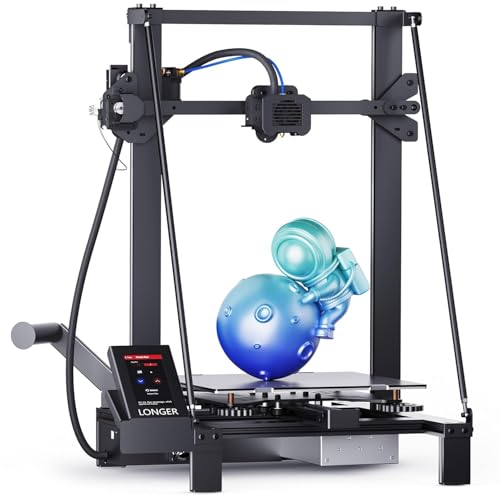
This variation emphasizes an open-source motherboard and TMC 2209 drivers with resume printing, enabling enthusiasts to customize firmware and integrate upgrades. The build retains a generous 300 x 300 x 400 mm workspace and a design tuned for precision. Automatic calibration reduces manual calibration time and vibration, providing smoother prints and better surface finish for larger parts. It remains a good match for makers who want more control over hardware and software configurations while staying approachable for learners.
FLASHFORGE AD5M Pro — Auto Leveling and Quiet Operation

The FLASHFORGE AD5M Pro combines a versatile form factor with a focus on quiet, reliable printing. It features a fully enclosed design and a one-click auto-leveling system, reducing manual calibration steps and ensuring a consistent first layer. The closed structure with dual filtration improves air quality, making it suitable for classrooms and home use where noise and emissions matter. While it offers a more compact footprint than some large-volume models, it remains capable of handling sizable projects within its build area and is well-suited for educational demonstrations and family-friendly projects.
FLASHFORGE AD5X Multi-Color 3D Printer

The AD5X Multi-Color 3D Printer supports multi-color capabilities with up to four colors simultaneously, thanks to a color filament system. It employs a CoreXY architecture and 1-click auto leveling to cut setup time and improve consistency across multi-color prints. With a large bed area of 220 x 220 x 220 mm, it’s ideal for projects requiring color complexity and rapid iteration. The combination of speed, color capability, and straightforward workflow makes it appealing for design studios and educators exploring color-rich prototyping.
ELEGOO Neptune 4 Plus — High Speed With Auto Level

The Neptune 4 Plus from ELEGOO is designed for fast, reliable printing with speeds up to 500 mm/s via Klipper firmware and accelerations up to 12,000 mm/s². Its large build volume measures 320 x 320 x 385 mm, providing ample room for bigger designs and multiple parts in a single print. Automatic bed leveling and a direct-drive extruder support precise extrusion, while input shaping and acceleration sensors help maintain accuracy at higher speeds. The combination of speed and scale positions it as a strong choice for ambitious hobbyists and classrooms working on sizable projects.
FLASHFORGE Adventurer 5M — Auto Leveling & High-Speed CoreXY

The Adventurer 5M emphasizes automated bed leveling and a fast CoreXY design capable of up to 600 mm/s travel speed. It features a 280°C direct extruder, a detachable nozzle, and a robust all-metal structure for durable, high-speed performance. The printer’s integrated chamber or dual-sided PEI platform supports diverse materials and easy post-processing, while its fast warm-up and nozzle-change capability streamline workflows in school or makerspace settings. It suits projects that require rapid production alongside reliable first-layer quality.
Creality Ender 5 Max — Large Print Area and Speed
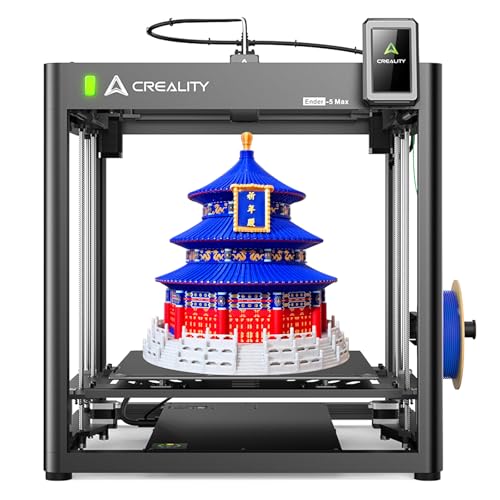
The Ender 5 Max offers a substantial print area of 400 x 400 x 400 mm with ambitious high-speed capabilities. A 64-point auto-leveling system helps yield a smooth first layer, while powerful drive components enable faster X and Y movement. This combination supports large, detailed prints with reduced manual calibration. The Ender 5 Max is suitable for users aiming to print sizable parts, batch components, or create large-scale prototypes, all within a relatively approachable desktop platform.
Creality K2 Plus Combo — Multicolor and Large Volume

The K2 Plus Combo integrates a large build volume of 350 x 350 x 350 mm with a multicolor capability via the Color Filament System (CFS). The CFS unit allows up to 16-color blending in a single print, expanding creative options for multi-tone models, signage, and parts where color differentiation matters. It achieves high-speed performance with up to 600 mm/s extrusion and is designed for quieter operation at 45 dB. This combination is well-suited for design studios, schools, and makerspaces pursuing color-rich prototypes and large-format prints.
Buying Guide: Large-Build-Volume 3D Printer Considerations
- Build volume versus footprint: Larger builds enable bigger parts but require more bench space and robust framing. Consider whether you need the full volume for a single print or if you can consolidate parts into multiple runs.
- Frame stability and vibration tolerance: Printers with triangular or reinforced frames often perform better on long prints. Pay attention to frame rigidity, linear rails, and calibration systems to ensure repeatable results.
- Extruder and nozzle options: Direct-drive versus Bowden, nozzle sizes, and material compatibility influence print quality and speed. For flexible materials or high-temperature filaments, a robust hot-end is crucial.
- Auto-leveling and calibration: Auto bed leveling reduces setup time and improves first-layer consistency, which is vital for large prints where a poor first layer can ruin an entire job.
- Speed versus accuracy: High-speed printing can introduce vibrations and quality drop-offs. Look for printers with velocity tuning, vibration control, and firmware features that preserve accuracy at higher speeds.
- Open-source and upgrade potential: Open-source boards and upgrade paths allow firmware tweaks, better hotends, and improved electronics. This can extend the printer’s useful life.
- Material support: Ensure the printer supports the materials you plan to use (PLA, ABS, PETG, nylon, composites). Larger builds may need better bed adhesion, enclosure, and thermal stability for certain materials.
- Noise and enclosure: For home or classroom use, quieter machines with enclosed chambers reduce disruption and improve safety for new users or younger students.
- Maintenance and parts availability: Large-volume printers may require more frequent alignment, part replacements, and calibration. Check access to spare parts and service options.
- Cost of ownership: Beyond the upfront price, consider filament costs, replacement parts, and potential upgrades that may be needed to maintain performance over time.