Choosing the right 3-phase BLDC motor controller is essential for reliable speed control, smooth direction changes, and robust protection in DC motor projects. This guide features five top-rated options that cover sensorless and Hall-based configurations, wide voltage ranges, and built-in forward/reverse/brake capabilities. Each pick is summarized below, followed by in-depth product sections and a practical buying guide to help you compare performance, heat management, and compatibility with your motor.
| Product | Brand | Key Advantage |
|---|---|---|
| LYWS High Speed Three-Phase DC Controller | LYWS | Works without Hall sensors; 6.5-24V; up to 15A, expandable with cooling |
| GODIYMODULES 3-Phase Hall Controller Board | GODIYMODULES | Hall-enabled, forward/reverse, PWM/analog speed control |
| YELUFT 6-60V 400W PWM Hall Controller | YELUFT | PWM/analog speed control; 6-60V range; supports Hall wiring |
| Ransanx Hall Motor Controller 400W | Ransanx | Forward/reverse/stop/brake; PLC 0-5V control; wide voltage |
| Walfront 5V-36V 15A Brushless Controller | Walfront | 3-phase brushless design; CW/CCW; simple potentiometer speed control |
LYWS High Speed Three-Phase DC Controller

The LYWS controller is a DC three-phase brushless Hallless control board designed to run without Hall sensors, expanding its suitability for motors that do not include Hall feedback. It operates in a voltage range of 6.5-24V and delivers a rated drive current of 15A, with a recommended boost to 30A when a cooling fan is added. This flexibility supports compact, cost-effective setups where sensorless operation is acceptable, while maintaining straightforward control and reliable performance.
GODIYMODULES 3-Phase Hall Controller
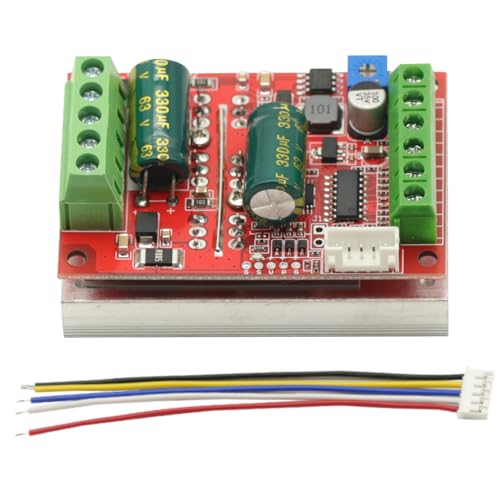
This 3-phase hall sensor driver provides attended control for Hall-equipped motors. The board features MA, MB, MC phase outputs and Ha, Hb, Hc hall inputs, with a built-in +5V supply. It supports forward/reverse operations and a brake/stop interface, making it suitable for PLC-driven setups. The optional potentiometer can be used for speed control, and the board is compatible with PWM input signals for precise speed tuning.
YELUFT 2-Pack 6-60V 400W PWM Hall Controller
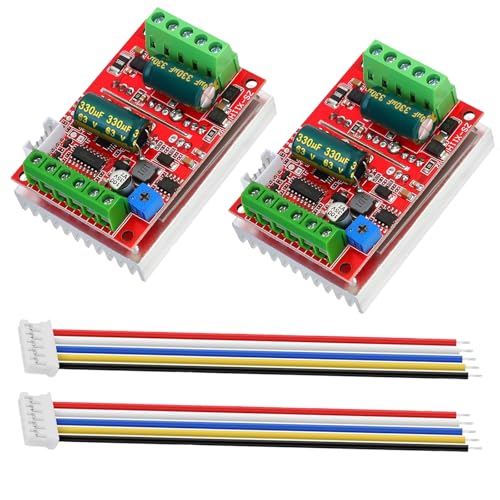
This product package includes two PWMs capable of handling a 6-60V range with a maximum rated power of 400W. It uses Hall sensor inputs with MA, MB, MC phase outputs and +5V/GND supplies, making it compatible with motors that have five Hall wires. The controller supports 0-5V speed control signals and PWM modulation, giving users flexible analog or digital speed control along with forward/reverse and brake/stop functionality. It is designed for 120-degree Hall angle motors and emphasizes stable, robust performance in compact applications.
Ransanx Hall Motor Controller 400W

Ransanx offers a 400W DC three-phase brushless controller with Hall sensor support. It includes forward/reverse/stop/brake controls, PLC-compatible 0-5V input for speed, and PWM compatibility. The wiring pattern emphasizes MA/MB/MC phase outputs and Ha/Hb/Hc hall inputs, along with a built-in 5V supply on the main board. The design targets reliable operation for 6-60V motor systems with comprehensive control features suitable for automation projects.
Walfront 5V-36V Brushless Controller

Walfront’s controller is designed for easy setup with a 5V-36V DC brushless motor, allowing speed adjustment via a potentiometer. It supports 3-phase brushless motors and offers CW/CCW operation. The device emphasizes straightforward operation, protection against overcurrent, and practical cost-effectiveness for hobby projects or simple automation tasks where minimal wiring and hassle-free performance are desired.
Buying Guide: Key Purchase Considerations
- Motor type compatibility: Sensorless vs Hall-sensor driven. Sensorless controllers work with motors lacking Hall sensors but may have tuning limitations at low speeds. Hall-based controllers provide enhanced control and feedback for smoother startup and RPM precision.
- Voltage and current range: Verify the motor’s operating voltage (e.g., 6-60V) and its peak/continuous current. Select a controller with headroom to prevent overheating and stall under load.
- Control interface: PWM vs analog 0-5V control, potentiometer speed adjustment, or PLC compatibility. Choose based on your control system and integration needs.
- Protection features: Overcurrent, short-circuit protection, braking, and reverse-stop safety. Built-in protections extend motor life and reduce risk.
- Wiring complexity: Hall wiring (Ha, Hb, Hc plus power lines) can be intricate. Ensure the controller’s wiring matches your motor’s Hall interfaces and the available power supply.
- Heat management: Higher power outputs require adequate cooling. Consider fans or heat sinks, especially for 400W-class controllers in enclosed spaces.
- Physical form factor and mounting: Check the board dimensions, connectors, and mounting holes to fit your enclosure and chassis layout.
- Documentation and support: Access to clear wiring diagrams, voltage ranges, and usage notes helps reduce setup time and errors.
- System goals: Decide whether you need rapid direction changes, precise speed ramping, or sensorless simplicity for a cost-conscious build.
When selecting a 3-phase BLDC motor controller, align the device with your motor’s Hall configuration, voltage, and power demands. A controller with integrated braking and robust control interfaces is advantageous for automation projects, while simpler, cost-effective models suit hobbyist applications.