Choose from top-rated 19-pin HDMI cables designed to support the latest video standards, from 8K to 4K120/144Hz gameplay, camera monitoring, and pro-television workflows. This guide highlights five reliable options, outlining key features, build quality, and when to select each for gaming, filmmaking, or professional use.
| Product | Brand | Approx. Length |
|---|---|---|
| Silkland Certified HDMI 2.1 Cable | Silkland | 6.6 ft |
| Portkeys 8K HDMI Cable (1 m) | Portkeys | 1 m |
| SHKI 8K/4K 2.1 HDMI Cable | SHKI | 1.5 ft |
| Portkeys 8K HDMI Cable (0.5 m) | Portkeys | 0.5 m |
| StarTech.com 7m CL3 HDMI Cable | StarTech.com | 7 m |
These selections cover high-refresh gaming, camera monitor connections, in-wall installations, and long runs with robust shielding. Each option provides strong signal integrity, 19-pin mapping, and durable constructions suitable for demanding setups without compromising video or audio quality.
Silkland HDMI 2.1 Cable With E-Braid

The Silkland cable is HDMI 2.1 certified and designed to support 4K at 120Hz, 144Hz, and up to 8K at 60Hz. It uses a double-layer “E-Braid” construction with nylon braiding for durability, copper cores, and ferrite beads to minimize interference. The product targets gamers and home theater enthusiasts seeking future-proof performance on current consoles and PCs. The certificate helps verify compliance, and the high bandwidth of 48 Gbps enables advanced features like HDR10+ and enhanced audio return channel (eARC).
Portkeys 8K HDMI Cable (1 m)
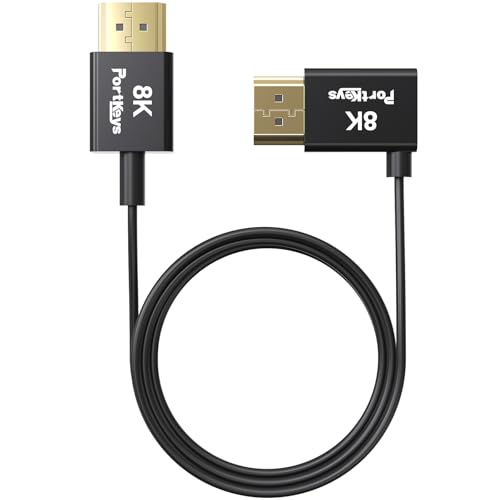
This Portkeys cable features full 19-pin mapping with grounded isolation, ensuring robust data and control signal transfer. The coaxial core uses high-purity oxygen-free copper with multi-layer shielding to minimize interference. A dual connector design (straight and right-angle) offers flexible routing in tight studios or camera setups, delivering stable, lossless transmission at 8K/60Hz and 4K up to 240Hz.
SHKI 8K/4K HDMI Cable (1.5 ft)
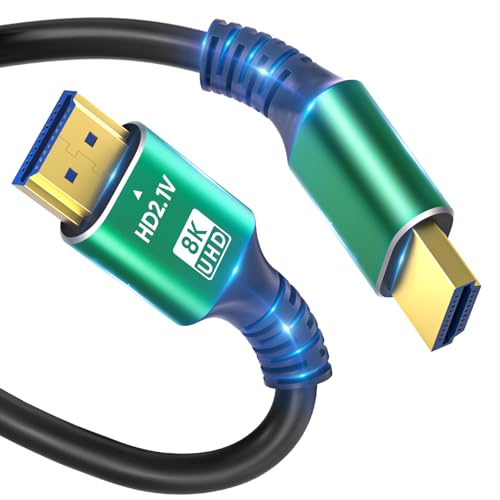
The SHKI HDMI 2.1 cable emphasizes high-speed performance for 8K at 60Hz and 4K at 120Hz, with HDR10 support and HDCP 2.2/2.3. It comes with a visually distinct green connector head for quick identification in meetings or studios. The cable promises backward compatibility with older HDMI versions while maximizing motion clarity and display resolution, making it suitable for next-gen consoles, high-refresh-rate PCs, and streaming devices.
Portkeys 8K HDMI Cable (0.5 m)

Similar to the 1 m version, this 0.5 m Portkeys cable provides full 19-pin mapping and grounded isolation with a 10-core coaxial structure for high data integrity and low signal loss. The dual connector design supports tight setups between cameras and monitors or small studio gear, maintaining reliable performance for 8K60Hz or 4K240Hz workflows.
StarTech.com 7m In-Wall HDMI Cable

This CL3-rated in-wall HDMI cable is designed for home or commercial installations. It supports high-speed HDMI with Ethernet and 4K video at up to 60 Hz. The 7-meter length makes it suitable for running through walls in home theaters or conference rooms. The construction uses 30 AWG conductors with gold-plated connectors and EMI shielding, increasing signal integrity over longer runs and reducing interference from nearby electrical devices.
Buying Guide: Key Considerations for 19-Pin HDMI Cables
- HDMI specification and certification: For future-proofing, prioritize HDMI 2.1 cables that support 4K120/144Hz and 8K60Hz, plus features like HDR and eARC. Verify with official certification when possible.
- Bandwidth and signaling: Look for cables rated at 48 Gbps or higher, which enables the highest refresh rates and color depth without compression or artifacts.
- Construction and durability: Consider braided jackets, ferrite cores, and robust connectors. For long runs or in-wall installations, CL3 ratings and in-wall-friendly designs reduce fire risk and meet building codes.
- Pin mapping and isolation: Full 19-pin mapping and grounded isolation help ensure compatibility across devices, plus improved control signal transfer for cameras and monitoring systems.
- Form factor and routing: Straight versus right-angle connectors reduce strain in tight setups. Shorter cables are great for monitors or devices close together; longer runs require careful shielding.
- Compatibility and future-proofing: While backward compatibility exists, ensure your devices (gaming consoles, PCs, AV receivers, cameras) can fully utilize the cable’s capabilities.
- Use case alignment: Gaming and PC use benefit from 4K120/144Hz and 8K60Hz; professional monitoring or camera setups may prioritize signal integrity, isolation, and connector options.