Choosing the right 16 segment LCD display can unlock new possibilities for projects requiring alphanumeric indicators, status readouts, or message boards. The following selections emphasize reliability, ease of use with common microcontrollers, and clear visibility in both indoor and outdoor environments. Each product below is suitable for hobbyists and professionals aiming to add vivid, programmable displays to their builds.
Summary of chosen products:
| Product | Display Type | Interface | |
|---|---|---|---|
| 16×2 LCD | I2C | Arduino, Raspberry Pi projects | |
| YOURRYONG 10 Bit 16 Segment SPI LCD Display | 16 Segment | SPI TM1622 | Learning boards, DIY displays |
| LCD Screen 10 Bit 16 Segment Display Module (Blue Backlight) | 16 Segment | SPI/TI interface (TM1622 driver) | Electronic components projects |
| Teyleten Robot LCD1602 16×2 | 16×2 LCD | I2C (PCF8574T) | Raspberry Pi, Arduino basics |
| QCCAN 4-Pack 1602 I2C Display | 16×2 LCD | I2C | Multi-unit projects, dashboards |
Hosyond 3pcs I2C 1602 LCD Display Module

The Hosyond kit includes three 16×2 LCD displays with an I2C interface, simplifying wiring for Arduino and Raspberry Pi projects. Each module supports a 2-line by 16-character display with a blue backlight. An integrated potentiometer controls brightness, while another knob adjusts contrast. Typical power is 5V with a default I2C address of 0x27. Wiring follows a simple GND—GND, VCC—VCC layout with SDA on A4 and SCL on A5. This package is useful for multi-display dashboards or demonstration boards where compact, legible text is required.
16-Segment / 7 Segment Display 2.3″ Alphanumeric LED

This module features a 2.3-inch alphanumeric LED display with 16 segments and 7 segments available for composed characters. The red, super-bright LED output ensures visibility in outdoor and indoor environments. With a compact form factor (69.8mm x 47.9mm x 10mm), it is well-suited for signage, indicators, or custom counters in embedded projects. It is ideal for developers seeking a bold, eye-catching display option with straightforward integration and strong legibility.
YOURRYONG 10 Bit 16 Segment SPI LCD Display TM1622

The YOURRYONG board provides a 10-bit 16-segment display driven via SPI using the TM1622 controller. This learning board is designed to help users explore segment-based displays without pin-intensive wiring. The package emphasizes a simple interface, enabling quick prototyping for educational kits, hobby projects, or proof-of-concept dashboards. It is especially useful for demonstrations requiring clear alphanumeric presentation and modular expansion.
LCD Screen 10 Bit 16 Segment Display Module (Blue Backlight)

This 10-bit 16-segment display module features a blue backlight and a SPI interface suitable for TM1622-compatible drivers. Marketed for reliability and precision, it is suitable for compact indicators, status panels, and educational electronics. The listing highlights ease of installation and a versatile range of applications from industrial to consumer electronics, making it a practical addition to both hobbyist and professional setups.
Teyleten Robot LCD1602 16×2 Module

The Teyleten Robot LCD1602 module provides a classic 16×2 character display with a blue backlight and a PCF8574T I2C controller. It offers a wide viewing angle and high contrast, suitable for projects that require readable text in various lighting conditions. The board adopts the HD44780-compatible LCD controller, ensuring compatibility with common libraries and example tutorials for Arduino and Raspberry Pi ecosystems.
FREENOVE I2C IIC 1602 Module (2 Pack)

The FREENOVE 1602 I2C module offers two units with I2C communication, reducing port usage compared to parallel interfaces. The conversion circuit is integrated for improved stability, and a step-by-step tutorial is provided. This kit is ideal for learners who want a reliable, easy-to-use display with broad compatibility across Arduino, Raspberry Pi, Pico, ESP32, and ESP8266 platforms. It emphasizes accessible setup and practical guidance for new users.
QCCAN 4-Pack 1602 LCD I2C Display
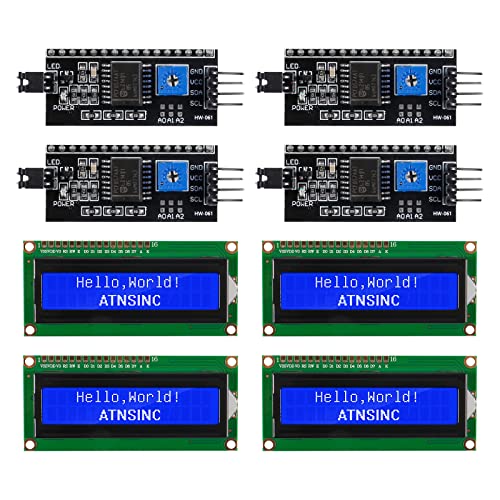
The QCCAN 4-pack provides 16×2 LCD displays with I2C backlighting and a standard PCF8574T/AT controller. Each module uses a default address of 0x27 (or 0x3F on some variants) and includes wiring guidance for GND, VCC, SDA, and SCL. The I2C interface minimizes I/O usage and simplifies integration into Arduino, Raspberry Pi, and similar microcontroller projects. The multi-pack option supports scalable dashboards or side-by-side data readouts.
is 5V 1602A Red LCD Module

The 1602A red character LCD module uses a parallel interface, offering a classic, high-contrast red character presentation on a black background. While not I2C by default, it remains compatible with basic microcontroller projects that prefer parallel wiring. This option is valuable for users seeking a traditional display style with straightforward character rendering and reliable readability in various environments.
Buying Guide: Key Purchase Considerations And Comparisons
Interface type matters: I2C and SPI modules save I/O pins and simplify wiring, while parallel 1602 displays are straightforward but require more pins. Consider controller compatibility (HD44780 family and TM1622 drivers) to ensure library support and community examples.
Display readability and backlight: Blue or red LED backlights influence visibility in different lighting conditions. For outdoor or bright indoor spaces, higher-contrast segments and robust backlighting are advantageous.
Addressing and wiring: I2C modules typically use a fixed address (often 0x27 or 0x3F) but verify compatibility with your microcontroller and any I2C multiplexing requirements. SPI-based modules may use TM1622 with specific wiring and firmware support.
Power and voltage: Most modules operate at 5V. Some boards advertise low-power operation or require stable 5V supplies. Ensure your power source matches module requirements to prevent brightness drift or failure.
Package and quantity: Kits with multiple displays are ideal for multi-panel dashboards or prototypes. If you only need a single display, a single-module option reduces cost and complexity.
Documentation and tutorials: Modules with integrated tutorials help new users, especially for Raspberry Pi or Arduino environments. Look for boards with clear wiring diagrams, sample code, and libraries that align with your platform.
Durability and environment: Outdoor or rugged use may benefit from sealed LEDs and strong backlights. For indoor hobby projects, standard modules with standard LCDs provide adequate performance at a lower cost.
Future-proofing: Consider modules with widely supported drivers (HD44780-compatible or TM1622) to ensure long-term compatibility as you expand your project repertoire.