Finding reliable AA rechargeable batteries means balancing capacity, recharge cycles, and compatibility with your devices. This guide reviews top 12-pack options, including NiMH and lithium variants, to help you choose the right mix for remote controls, cameras, toys, and more. Below are five standout picks with practical insights on performance, charging needs, and long-term value.
| Product | Type | Capacity / mAh | Charge Cycles | Best For |
|---|---|---|---|---|
| Amazon Basics 12-Pack Rechargeable AA NiMH (2000 mAh) | NiMH | 2000 | Up to 1000x | General household devices, toys, remotes |
| Homesuit Rechargeable AA Lithium (3600mWh) | Li-ion | 3600mWh | 2000+ cycles | High-drain devices, time-lapse gear |
| Amazon Basics 12-Pack Rechargeable AA NiMH (2400 mAh) | NiMH | 2400 | Up to 400x | High-drain controllers and gaming |
| Brightown 12-Pack Rechargeable AA (1000mAh) | NiMH | 1000 | Up to 1000x | Budget-friendly, solar lights, general use |
| RayHom 12-Pack Rechargeable AA Lithium with Charger (3700mWh) | Li-ion | 3700mWh | Up to 1600x | Smart devices, cameras, gaming gear |
Note: All options support multiple recharge cycles and are designed for common 1.5V devices. NiMH cells are compatible with most household tools, while lithium variants excel in high-drain gear and rapid cycling scenarios. The right choice depends on your device compatibility, power needs, and how often you recharge.
Amazon Basics 12-Pack NiMH (2000 mAh)

These AA NiMH batteries deliver reliable performance with a capacity of 2000 mAh per cell. They’re designed for broad device compatibility, making them suitable for remotes, flashlights, toys, wireless devices, and game controllers. A key advantage is the ability to be recharged up to 1000 times with only minor capacity loss, which translates to long-term cost savings and reduced waste. If your daily routine involves frequent battery swaps, these can be a dependable staple in a household power kit.
Homesuit Li-ion AA (3600mWh) With 12-Bay Charger

Homesuit’s lithium AA batteries offer a high 3600mWh capacity and a constant 1.5V output. They promise 2000+ recharge cycles and are compatible with high-drain devices like outdoor cameras, gamepads, VR gear, and RC toys. The pack includes a 12-slot charger, and the cells are designed to optimize space usage with CBPI technology for improved efficiency. These are best for users who need steady performance in demanding electronics and want a single, long-lasting power solution for multiple devices.
Amazon Basics NiMH 2400 mAh AA (12-Pack)

With 2400 mAh capacity per cell, these NiMH AA batteries are well-suited for devices that demand higher power, such as game controllers, toys, and wireless devices. They’re designed to hold up to 400 recharge cycles, which makes them a practical option for households that rely on rechargeable power for frequent use items. The higher capacity helps extend run times between charges, reducing the need for constant replacement and offering better efficiency for energy-intensive gadgets.
Brightown 12-Pack AA Batteries (1000mAh)
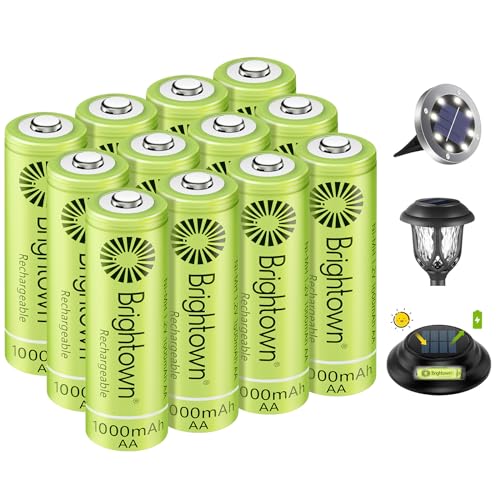
Brightown offers a budget-friendly option with 1000 mAh NiMH cells that can be recharged up to 1000 times. They arrive pre-charged to a usable level, but the manufacturer notes a 30% initial charge for safety during transport. These are suitable for lower-drain devices and general-use scenarios, such as remote controls and basic flashlights. They represent an economical entry point into rechargeable AA power, especially for households that rarely drain batteries in high-drain gear.
RayHom 12-Pack Li-ion AA Batteries With Charger (3700mWh)

RayHom’s lithium AA batteries provide a large 3700mWh capacity with a constant 1.5V output, designed for high-performance devices. The 12-slot charger supports independent charging for each cell and includes smart charging protection. With up to 1600 recharge cycles, these packs offer extended lifespans for cameras, gaming gear, smart home devices, and other high-drain electronics. The charger uses USB-C for stable power delivery, delivering faster and safer recharges compared with conventional NiMH setups.
Buying Guide: Key Considerations For 12 Pack AA Batteries
When selecting 12-pack AA batteries, consider device compatibility, discharge rate, and charging infrastructure. NiMH cells are widely compatible with most household devices and have mature recycling pathways, while lithium AA options can deliver higher energy density and better performance in high-drain gear. Here are essential factors to weigh:
- Type and chemistry: NiMH for broad compatibility and cost-effectiveness; lithium for high-drain devices and longer run times per cycle, especially in cameras and gaming controllers.
- Capacity and cycle life: Higher mAh often translates to longer run times, but real-world performance depends on device load and discharge rate. Check the expected recharge cycles to gauge long-term value.
- Voltage stability: Most devices expect a steady 1.2V for NiMH and 1.5V nominal for alkaline or lithium alternatives. Lithium AA can maintain voltage better under load, improving performance in demanding devices.
- Charger compatibility: Some packs include a dedicated charger; ensure the charger supports your preferred number of slots and has safety protections such as overcharge and temperature safeguards.
- Storage and self-discharge: Low self-discharge NiMH cells retain capacity well when not in use. For long-term storage, consider batteries rated for low self-discharge and include storage cases.
- Environmental impact: Rechargeable options reduce waste. The lifecycle cost varies with cycle counts, so higher-quality cells may offer greater total savings over time.
- Climate and environment: Lithium AA cells tend to perform better in extreme temperatures, which can be important for outdoor equipment or cameras in varying climates.
Device availability and user needs drive the final choice. For casual, everyday devices, NiMH packs with solid cycle life (around 400–1000 cycles) offer dependable value. For high-drain or outdoor equipment, lithium variants with higher capacity and longer cycle endurance may justify the premium. Always pair batteries with a compatible charger and consider having a dedicated set of batteries for essential devices to minimize downtime.