Selecting the right 100Base-TX to 100Base-FX media converter helps extend Ethernet networks over fiber, reduce interference, and simplify remote site connectivity. This guide highlights five reliable options, covering standalone devices, automotive-grade variants, and multi‑mode/ single‑mode capabilities. Each product section links to its Amazon listing for quick access to specs and user reviews, while the buying guide below explains key factors to consider when choosing a converter for your environment.
Summary of Selected Products
- XMSJSIY Fiber Ethernet Media Converter, Single-Mode 10/100Base-TX to 100Base-FX
- Transition Networks Media CONVRT 100BASE-TX RJ45 100BASE-FX
- 10Gtek 10/100Mbps Fast Ethernet Media Converter, Single-Mode SC Fiber
- TP-Link Fast Ethernet SFP to RJ45 Fiber Media Converter
- Intellinet 506519 Fast Ethernet Media Converter 10/100Base-TX to 100Base-FX
XMSJSIY Fiber Ethernet Media Converter
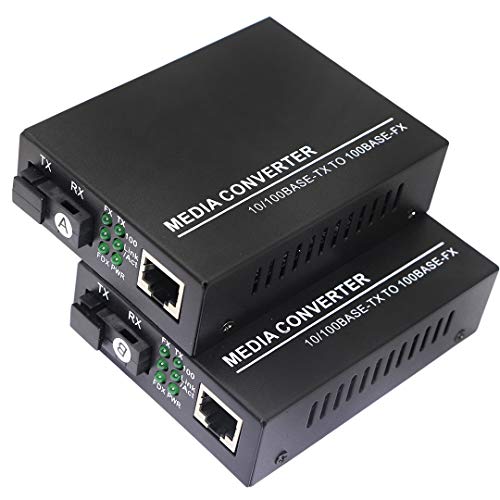
The XMSJSIY converter provides a cost-effective solution for extending networks with strong interference resistance and stable data transmission. It combines an RJ45 port for 10/100Base-TX with a single-fiber SC port for 100Base-FX, enabling a straightforward optical conversion over up to 25 kilometers on single-mode fiber. The device emphasizes reliable performance through a high-quality metal housing and thoughtful heat-dissipation design, making it suitable for both indoor and certain outdoor environments. The core optical fiber channel reduces complexity by using a single fiber path, which can improve reliability in some deployments. This model targets users who need a compact, durable unit for medium-range fiber extensions while maintaining simple management and solid transmission characteristics.
Key considerations:
- Single-mode SC fiber, up to 25 km, suitable for campus or enterprise links
- RJ45 to SC fiber conversion for 10/100Base-TX to 100Base-FX
- Durable metal housing with cooling design for continuous operation
Transition Networks Media CONVRT 100BASE-TX RJ45 100BASE-FX

The Transition Networks converter emphasizes straightforward, two-port functionality that supports basic bridging between 100Base-TX copper and 100Base-FX fiber. With two ports total—RJ-45 and a fiber interface—this unit is well-suited for edge deployments, where a compact, easy-to-manage device is desirable. It operates at layer 1, ensuring that data moves through the converter with low latency, which is helpful for time-critical tasks or legacy Ethernet links requiring simple upgrades to fiber connectivity. This option is appropriate for environments where a streamlined, plug-and-play approach is preferred, rather than feature-rich management capabilities.
Key considerations:
- Two-port, RJ-45 to fiber converter, straightforward deployment
- Layer 1 operation for low latency
- Ideal for small office or remote site connections requiring fiber backhaul
10/100Mbps Fast Ethernet Media Converter (Single-Mode SC, up to 20km)

This 10Gtek model adds an affordable option for users needing 10/100Base-TX to 100Base-FX conversion with single-mode fiber. It supports a dual SC fiber configuration and delivers 100Mbps Ethernet over fiber, with both full-duplex and half-duplex operation and auto-crossover capabilities. The device aligns with IEEE 802.3 standards and supports MDI/MDI-X auto sensing to simplify installation. It targets budget-conscious deployments where reliable performance is required over longer fiber links without additional management features.
Key considerations:
- Single-mode SC fiber, up to 20 km
- RJ45 copper interface supports 10/100 Mbps
- Auto MDI/MDI-X and standard Ethernet compatibility
TP-Link Fast Ethernet SFP to RJ45 Fiber Media Converter

TP-Link’s offering bridges 100BASE-FX single-mode fiber with 100Base-TX copper using a standard SFP module approach. It supports full-duplex 100 Mbps on both ports, with auto MDI/MDIX on the copper side and configurable transfer behavior on the fiber side. This device is suitable where a flexible, standards-based solution is desirable, especially in environments that may already have SFP modules on hand or where cross-vendor interoperability is important. It is a practical option for buildings, campuses, or data centers needing straightforward fiber-to-Ethernet conversion without advanced management requirements.
Key considerations:
- 100Base-FX to 100Base-TX conversion with SFP-based fiber
- Auto MDI/MDIX and fixed/auto transfer mode options
- Good compatibility in mixed-vendor networks
Intellinet 506519 Fast Ethernet Media Converter

The Intellinet option focuses on a robust Fast Ethernet conversion path from 10/100Base-TX to 100Base-FX. The product is designed for 10/100Base-TX to ST fiber in some configurations, linking copper Ethernet to fiber with a straightforward, reliable interface. It is suitable for office or small data-center racks where a simple, sturdy media converter is needed. While not the most feature-rich, it offers solid performance for standard Ethernet backhaul and fiber extension tasks.
Key considerations:
- 10/100Base-TX to 100Base-FX conversion using ST interface
- Simple, dependable operation for standard Ethernet backhaul
- Rack-mountable form factor appropriate for small deployments
Buying Guide: How to Choose a 100Base-TX to 100Base-FX Media Converter
- Fiber type and distance: Decide between single-mode and multi-mode fiber, and the required link distance. Single-mode is typical for longer runs (up to tens of kilometers), while multi-mode suits shorter hops within buildings or campuses.
- Port configuration: Ensure the converter provides the correct copper interface (RJ-45) and fiber interface (SC, LC, or SFP-based). Verify whether you need a standalone device or an SFP-based module with switchable behavior.
- Duplex and speed: Most devices support 10/100 Mbps copper and 100 Mbps fiber; confirm full-duplex operation and auto MDI/MDIX if you want automatic detection of cable types.
- Management features: Some converters offer features like remote management, VLAN support, or status monitoring. If you require simple plug-and-play, opt for a model advertised as “stand-alone” or “non-managed.”
- Power and durability: Consider power requirements (external adapter vs. built-in) and enclosure durability (metal housing vs. plastic) for indoor vs. outdoor or rack-mount use cases.
- Environmental considerations: If the device will operate in harsh or outdoor environments, check for temperature ratings, weather sealing, and heat dissipation features.
- Upgrade path and compatibility: If your network already uses particular fiber types or SFP modules, verify compatibility with existing hardware to avoid interoperability issues.
- Cost vs. value: Compare not only price but also distance capabilities, supported fiber types, and form factor to determine overall value for your deployment.
In summary, the listed options provide a range of choices—from compact, basic converters intended for immediate lift-and-shift upgrades to more flexible units suitable for mid-sized networks. Assess your distance requirements, fiber type, port needs, and management preferences to select the best fit for your environment.
Notes on Product Selection
All products above are presented with their listed features as reference points. When evaluating options, consider which features align most closely with your network’s topology, existing cabling, and desired maintenance profile. The right converter should deliver reliable signal conversion with minimal latency while integrating smoothly into your current hardware ecosystem.